Text: Luke 15:11–32
Theme: Repentance opens the door for restoration.
The younger son looks his father in the eyes and demands his share of the inheritance. In that culture, inheritance only came after death. The son is essentially saying he wants the father’s wealth, but not his presence. He wants the resources, but not the relationship. His story begins with rebellion.
It is sin in its purest, most undignified form: self-rule, self-will, and self-destruction. And the father lets him go, because love never forces obedience.
The Deceit and Devastation of Sin
The son leaves home with pockets full and a heart empty. He wastes everything on reckless living, the kind that destroys a man from the inside out. He squanders his father’s wealth, his family’s honor, his own dignity, and his future.
When the money vanishes, so do the friends. A famine hits, and he becomes desperate enough to take a job feeding pigs – an unclean, deeply humiliating reality for a Jewish man. He is starving, filthy, and forgotten.
His sin took him further than he planned, kept him longer than he expected, and cost him far more than he imagined. This is the absolute gravity of sin. It always promises freedom, but it only ever delivers chains.
The Weight of Repentance
Sitting in the stench of the pigpen, the boy finally sees himself clearly. Scripture says, “He came to himself.” True repentance always begins with recognition.
He remembers his father. Not the wealth, but the goodness. He rehearses a confession in the mud: “I have sinned against heaven and against you. I am no longer worthy to be called your son. Make me like one of your hired servants.”
This is genuine repentance…not disguised as manipulation or a negotiation tactic. He is not returning to reclaim his rights; he is returning to beg for mercy. He rises from the mud and begins the long, humiliating walk home. Every single step is repentance in motion.
The Undignified Run of Grace
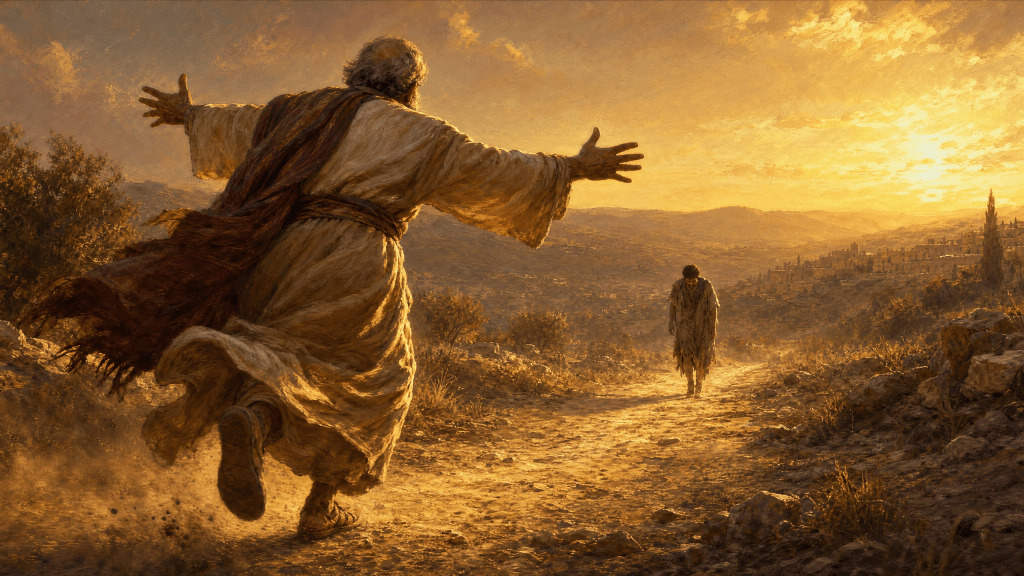
While the son is still far away, the father sees him. He has been watching the road, scanning the horizon for a silhouette he knows by heart.
And then occurs the most shocking moment in the parable: the father runs. In ancient Middle Eastern culture, an older, dignified patriarch never ran. It required lifting his robes, exposing his legs, and completely abandoning his dignity.
He runs toward the smell of pigs. He runs toward the glaring evidence of sin. He runs toward the boy who broke his heart. He runs because repentance has begun.
He embraces him. He kisses him. He covers him. The son tries to deliver his rehearsed confession, but the father interrupts him. Repentance opened the door, but grace completely fills the room.
Restoration Outruns Ruin
The father calls for the best robe to cover the boy’s shame. He calls for a ring to restore his authority. He calls for sandals to restore his dignity. He calls for a feast to restore the joy of the house.
The son expected severe consequences; the father gives him a celebration. The son expected distance; the father gives him an embrace. The son expected to be made a servant; the father restores him fully as a son.
The son’s sin was real, deep, and destructive. His repentance was sincere, humble, and costly. But the father’s mercy was immediate, overwhelming, and entirely undeserved. The father ran faster than the son walked. Restoration happened quicker than ruin. Grace outran guilt.
A Word to the Reader
Maybe you feel exactly like the prodigal right now. You have sinned deeply. You have wandered far. You have wasted seasons, squandered opportunities, or compromised your purity. You feel utterly unworthy to return, convinced that your repentance will only be met with rejection or a lecture.
This story speaks directly into that fear. Repentance is the road home, and grace is the Father running toward you.
Your sin is not too heavy. Your past is not too dark. Your shame is not too deep. The Father is not standing on the porch waiting to punish you; He is waiting to restore you. When you finally turn, He runs. When you confess, He embraces. When you repent, He restores.
Prayer
Father, I bring You my sin, my shame, and my failures. Give me the courage to repent fully and return completely. Thank You for abandoning dignity to run toward me with mercy. Restore what I have wasted, and teach me to live again as Your beloved child. Amen.
 Devotional
Leave a comment