I once met a man who said his return to God began in the least religious place imaginable. He was not in a church, not listening to a sermon, and not surrounded by worshippers. He was alone in his car at two in the morning, parked under a dim streetlight, with years of guilt pressing against his chest. He had no hymn except silence and no offering except one broken sentence: “God, if You are real, I need You.”
That whisper was worship.
I have watched an elderly widow stand in a small church while the congregation sang an old hymn. Her husband had been buried only weeks before. Her hands trembled, her voice cracked, and grief sat visibly on her shoulders. Yet she sang, not because sorrow had disappeared, but because faith had not.
That song was worship.
Then there was a youth gathering where the music was loud, the lights were bright, and young people knelt, shouted, wept, clapped, and lifted their hands to Jesus. Some might call it too emotional. Others might call it refreshing. But beneath the sound and movement were hearts reaching for God.
That passion was worship.
Three scenes. Three expressions. One question: what makes worship truly Christian?
Worship Is Bigger Than Doctrine
This series begins there, not with denominational rivalry, but with Scripture open before us. Christians have always worshipped in different ways. Some gather with ancient prayers, candles, icons, and sacraments. Some gather around preaching, singing, and Scripture. Some worship with spontaneous prayer and lifted hands. Others are shaped by silence, confession, kneeling, and reverent order.
The differences are real. They are historical, theological, cultural, and emotional. A hymn may carry a grandmother’s faith. A prayer book may hold centuries of wisdom. A sermon may awaken love for the Word. Baptism may mark surrender. The Lord’s Table may proclaim the gospel in bread and cup. Because worship touches memory, conviction, and encounter, worship disagreements can quickly become identity disagreements.
So we must walk carefully.
Worship Must Be Tested by Scripture
Carefully does not mean vaguely. It does not mean pretending every practice is equally biblical or that doctrine does not matter. Scripture never treats worship as personal invention. From Abel’s offering to Abraham’s altar, from Israel’s tabernacle to David’s songs, from Isaiah’s trembling vision to the woman who broke her alabaster jar, worship is always a response to the revealed worth of God.
Jesus says the Father seeks worshippers who worship “in spirit and truth” (John 4:23-24). Paul calls believers to present their bodies as a living sacrifice, their spiritual worship (Romans 12:1). The early church devoted itself to the apostles’ teaching, fellowship, breaking of bread, and prayers (Acts 2:42).
That means worship is larger and deeper than music. It includes prayer, Scripture, preaching, singing, sacraments, giving, fellowship, obedience, holiness, mission, and daily surrender. It is gathered and scattered. It is ancient and immediate. It is personal and communal. It is doctrinal and devotional. Above all, it is God-centred.
The Journey Ahead
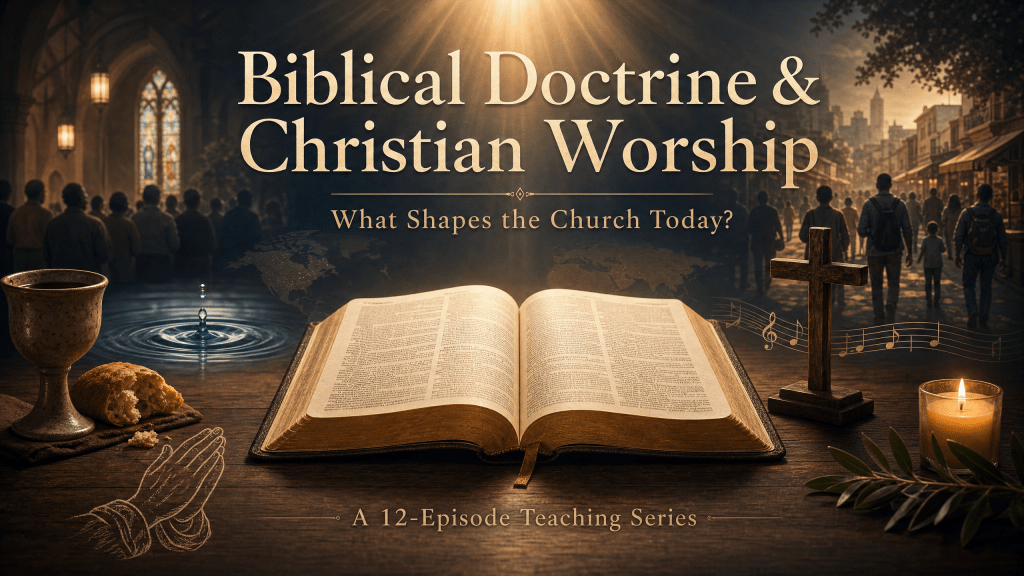
This journey asks how biblical doctrine forms church worship today. We will begin with God’s holiness, covenant, sacrifice, and worship in spirit and truth. We will examine what Scripture commands, what culture contributes, and how churches order prayer, preaching, praise, silence, kneeling, shouting, and reverence.
We will also enter difficult territory: images, icons, veneration, the Second Commandment, the incarnation, women in pastoral calling, giving, baptism, the Lord’s Supper, and community life. These subjects require courage, humility, and biblical seriousness because they shape how believers gather and serve.
Finally, we will end where true worship always sends us: into witness, evangelism, marketplace faithfulness, discipleship, and mission.
The Aim of the Series
The goal is not to flatten every tradition into sameness or make controversy disappear. The goal is to let Scripture test our assumptions, history humble our certainty, and love guard our tone. With open Bibles, teachable hearts, and reverence for Christ, these conversations can become more than debates.
They can become discipleship.
Because at the centre of Christian worship is not a style, denomination, ritual, song, sermon, icon, or platform. At the centre is the living God. He is holy. He is merciful. He is worthy.
And when the people of God truly see the worth of God, they respond with all they are.
Reflection Questions
1.Which expression of worship has most shaped your spiritual life: silence, song, Scripture, sacraments, prayer, preaching, or service?
2.Have you ever confused a worship style with worship itself?
3.What practice in your tradition needs to be freshly tested by Scripture with humility and love?
Prayer
Lord, teach us to worship You in spirit and truth. Deliver us from pride, carelessness, empty performance, and shallow judgment of others. Open our hearts to Scripture, deepen our reverence, and help us love Your church without losing devotion to Your Word. May this journey lead us beyond argument into discipleship, and beyond preference into surrender. Amen.
 Devotional
Leave a comment