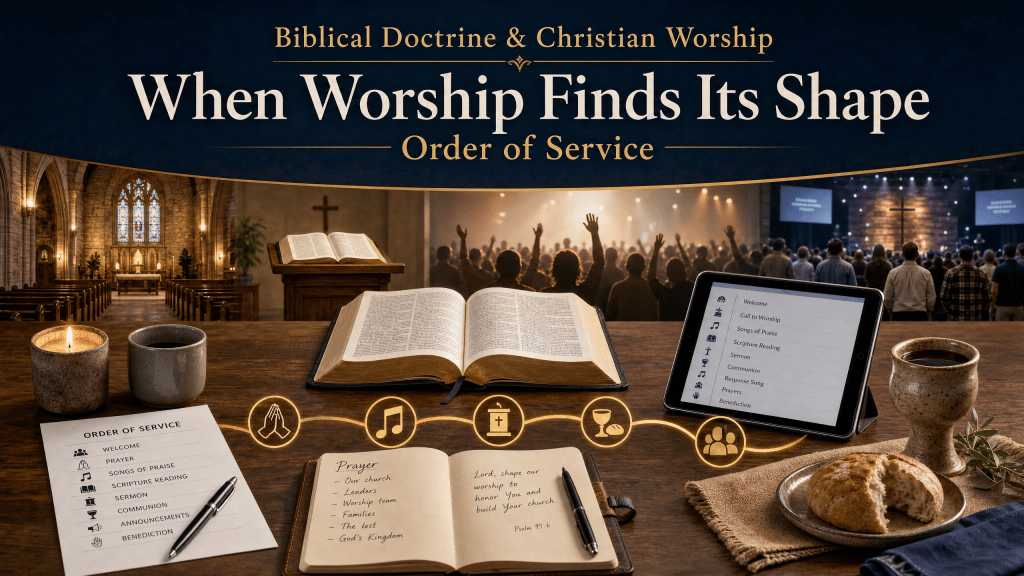
Order of Service: Is There a Biblical Pattern?
Maya arrived late because the church app said service began at 10:00, but the car park said otherwise. Ushers were still greeting people, the band was rehearsing one last chorus, and someone near the coffee table was explaining that “we usually start five minutes after we start.”
She smiled because she had seen the opposite too. In her grandmother’s Anglican church, the procession began on time, the readings followed the lectionary, and everyone seemed to know when to stand, sit, kneel, and respond.
Two churches. Two rhythms. One question in Maya’s mind: is there a defined order of service we can find in the bible?
The honest answer may surprise us. Scripture gives the church the elements of worship, but not one universal sequence. We are commanded to pray (1 Timothy 2:1), read Scripture publicly (1 Timothy 4:13), preach the Word (2 Timothy 4:2), sing with truth in our hearts (Colossians 3:16), share the Lord’s Supper (Luke 22:19), give with order and generosity (1 Corinthians 16:2), and continue in fellowship (Acts 2:42). These are practices God uses to form His people.
But the Bible does not say, “Start with three songs, then announcements, then offering, then a forty-minute sermon.” It does not say the Table must come before the sermon or after it in every gathering. God gives the ingredients. The church, under Scripture and the wisdom of the Spirit, shapes the meal.
That does not mean anything goes. Paul told the Corinthians, whose gatherings had become noisy and confused, “Let all things be done decently and in order” (1 Corinthians 14:40). Order is not the enemy of the Spirit. Disorder can distract the seeker, exhaust the saints, and hide the gospel beneath confusion. At the same time, order must never become a cage where no one expects God to speak, convict, comfort, or interrupt our pride.
This balance has shaped Christian history. In the second century, Justin Martyr described believers gathering on Sunday for Scripture readings, teaching, prayer, the Eucharist, and care for the needy. Over time, Catholic, Orthodox, and Anglican worship developed stable patterns filled with Scripture, creeds, prayers, and sacraments. Their strength is continuity and reverence. Their danger is routine without attention.
During the Reformation, many churches simplified worship. Reformers wanted the Word clearly read, preached, sung, and obeyed. Reformed and Baptist churches often placed the sermon near the centre, with congregational singing and prayer surrounding it. Their strength is biblical clarity. Their danger is becoming so minimal that worship feels more like a lecture than a gathered response to God.
Pentecostal and charismatic churches, shaped by revival movements, often leave more room for extended singing, testimonies, altar ministry, and spontaneous prayer. Their strength is expectancy and participation. Their danger is mistaking intensity for depth or spontaneity for the Spirit.
Many evangelical and non-denominational churches today arrange services with modern communication in mind. Transitions are planned, screens guide the congregation, sermons are practical, and services are often shorter. Their strength is accessibility. Their danger is allowing worship to be shaped more by attention span and consumer preference than by Scripture.
So what does God intend?
He intends worship to be intelligible, reverent, biblical, participatory, and Christ-centred. The unbeliever should not leave saying, “I could not understand what was happening” (1 Corinthians 14:23). The believer should not leave merely entertained. The church should be able to say, “We heard God’s Word, answered in prayer and song, remembered Christ, and loved one another.”
Not every element must appear in every meeting. The early church gathered for prayer, teaching, breaking bread, fasting, and mission. But across the life of a healthy church, the biblical elements should not disappear. A body cannot live on one food forever.
Your church may use a printed liturgy, a projected countdown, a spontaneous flow, or a simple outline. The real test is not whether the order feels familiar to you. The test is whether the order helps people behold God, receive His Word, respond with faith, and leave as witnesses.
A good order of service is not a performance schedule. It is a pathway for worship.
And when that pathway is shaped by Scripture, filled with love, and open to the Spirit, the church does not merely get through a service.
The church is formed.
Reflection Questions
1.What order of service shaped your earliest understanding of worship?
2.Which do you tend to value more: structure or spontaneity?
3.Are any biblical elements missing or weak in your worship life?
4.Does your church’s order help people understand and respond to God?
5.How can you come to worship less as a consumer and more as a participant?
Prayer
Father, teach me to worship You with both reverence and expectation. Guard me from empty routine and careless disorder. Let Scripture shape what I value, let love shape how I participate, and let Your Spirit keep my heart alive before You. Form our gatherings so Christ is seen, Your Word is heard, and Your people are sent in obedience. Amen.

 Devotional
Leave a comment