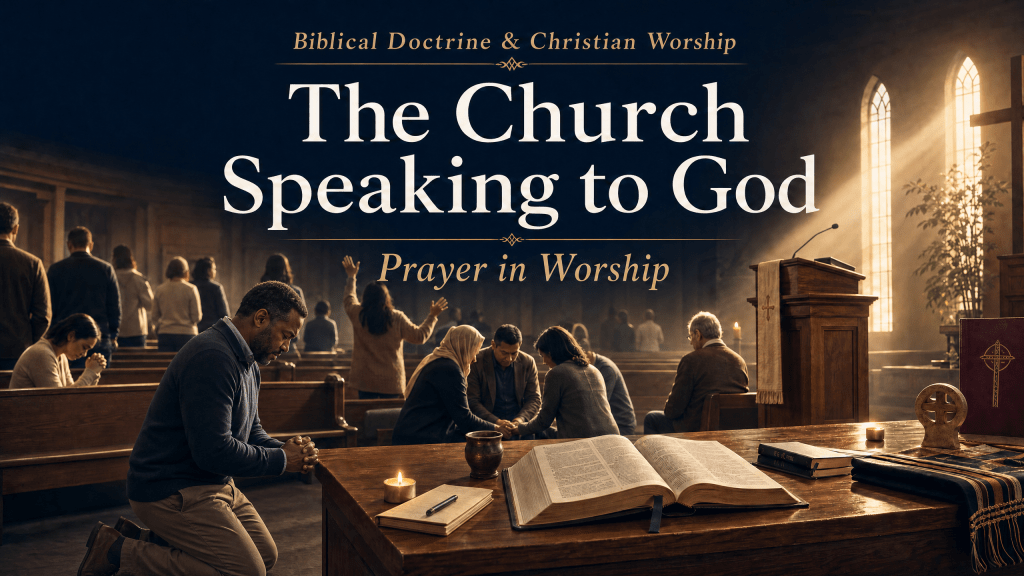
Before the first microphone was switched on, Pastor Daniel unlocked the side door and stepped into the quiet sanctuary. Outside, the bakery was warming bread. Across the street, buses carried nurses, students, traders, and tired parents into another Sunday.
Inside, the chairs waited.
Daniel walked to the front, knelt beside the first row, and whispered the same prayer he prayed every week.
“Lord, teach us to pray.”
He did not pray it because he lacked words. He prayed it because churches can have words without dependence. A service can move smoothly, a sermon can be strong, the singing can be beautiful, and yet the people of God can forget how deeply they need God.
Prayer is not filler during a church service. Prayer is one of the important moments. It is the church turning toward the Father, through the Son, by the Spirit.
Scripture places prayer near the heart of gathered worship. Paul writes, “First of all, then, I urge that supplications, prayers, intercessions, and thanksgivings be made” (1 Timothy 2:1). The early believers prayed together until the place was shaken and they were filled with boldness (Acts 4:31). They prayed when choosing leaders, when sending missionaries, when facing prison, when saying goodbye, and when breaking bread from house to house (Acts 1:24, Acts 13:2 to 3, Acts 12:5, Acts 20:36, Acts 2:42).
This tells us something practical. The Bible does not give one fixed prayer script for every service, but it gives the church a praying life. Sometimes prayer is confession, as when the tax collector cried, “God, be merciful to me, a sinner” (Luke 18:13). Sometimes it is thanksgiving, as Paul commands in Philippians 4:6. Sometimes it is intercession for leaders and nations (1 Timothy 2:2). Sometimes it is lament, like the Psalms that teach wounded hearts to speak honestly before God. Sometimes it is silence, because the Lord is in His holy temple (Habakkuk 2:20).
Across history, Christians have carried these biblical patterns in different vessels. Liturgical churches such as Anglican, Catholic, and Orthodox communities often use written prayers, psalms, collects, creeds, and litanies. Their strength is that prayer is protected from shallowness and rooted in Scripture and the worship of the wider church. Their danger is reciting holy words with wandering hearts.
Reformed and Baptist churches often value pastoral prayers shaped by doctrine, confession, thanksgiving, and intercession. Their strength is biblical clarity. Their danger is that prayer can quietly become another sermon, spoken to God but aimed mainly at people.
Pentecostal and charismatic churches often pray aloud, spontaneously, passionately, and corporately. Their strength is expectancy. Their danger is that volume may be mistaken for faith, or emotion for spiritual depth.
Many evangelical and non-denominational churches weave prayer briefly through transitions, before the sermon, after worship songs, or during response. Their strength is accessibility. Their danger is that prayer becomes functional, used to move the service along, rather than formative, used to shape the church’s dependence.
Culture also gives prayer its accent. In one congregation, everyone kneels in silence. In another, many voices rise at once. Some pray with formal language. Some pray like children speaking freely to their Father. Some lift hands, some bow heads, some walk the aisles, some sit still and weep.
The question is not, “Which style feels most spiritual?” The better question is, “Does this prayer help us seek God truthfully?” Jesus warned against prayer that performs for people (Matthew 6:5). He also warned against empty repetition (Matthew 6:7). Yet He gave His disciples a pattern to pray: Father, kingdom, daily bread, forgiveness, deliverance (Matthew 6:9 to 13). So prayer in worship must be sincere, but sincerity does not mean careless. It must be Spirit-led, but Spirit-led does not mean unbiblical. It must be ordered enough to guide and alive enough to depend on God.
What does God intend? He wants a praying church, not a performing church. He wants prayer that is central, corporate, honest, scriptural, dependent, Christ-centred, and kingdom-focused. Prayer is not meant to decorate the service. Prayer is meant to direct the service.
When the church prays, it remembers that worship is not self-expression first. It is dependence. We come needy, forgiven, and sent.
And before we speak about God, sing to God, or serve for God, we learn again to speak with God.
Reflection Questions
1.Does prayer in your church feel central or merely transitional?
2.Which forms of prayer are strongest in your worship: confession, thanksgiving, intercession, lament, silence, or petition?
3.Do you pray more from habit, emotion, performance, or dependence?
4.How can your church make prayer more biblically rich without making it lifeless?
5.What would change if your worship gathering truly became a house of prayer?
Prayer
Father, teach us to pray with humility, faith, and honesty. Save us from empty words, shallow performance, and prayerless worship. Shape our gatherings into places where Your people seek Your face, submit to Your will, and depend on Your Spirit. Let our prayers be rooted in Scripture, centred on Christ, and open to Your kingdom purposes. Amen.

 Devotional
Leave a comment