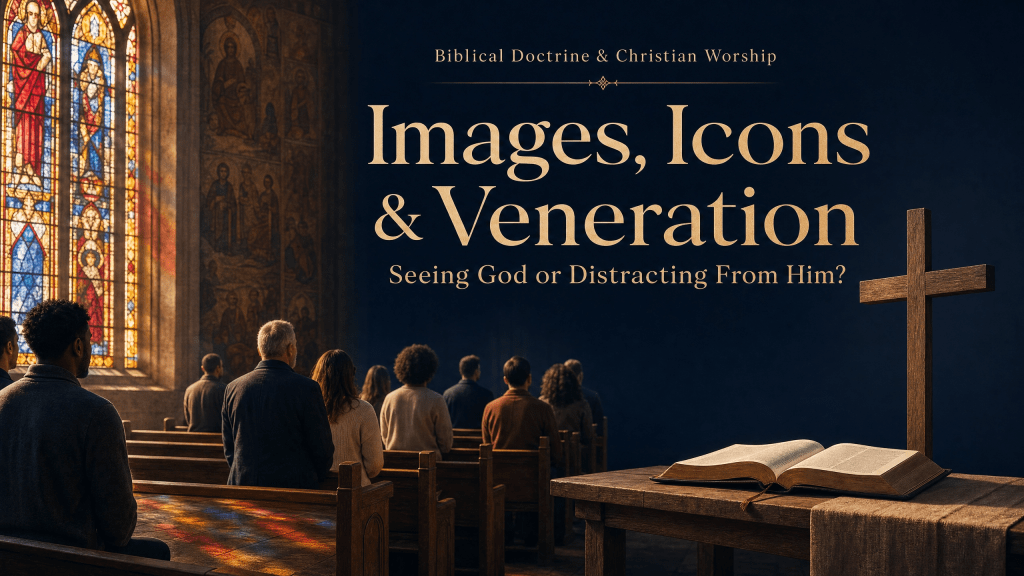
Two Rooms, One Question
Ruth stepped into the chapel just after sunrise. Candles flickered near the altar. Stained glass poured blue, red, and gold across the stone floor.
She was not Catholic or Orthodox. She had grown up where the walls were plain, the pulpit was central, and the Bible was opened first. Yet in that chapel, she felt pulled toward God.
A week later, she visited a Reformed congregation. No icons. No statues. Just Scripture read aloud and believers singing with conviction. Again, she felt drawn toward God.
Two rooms. Two traditions. One question: what does God actually want?
The Command We Must Obey
The Second Commandment is not unclear. God said, “You shall not make for yourself a carved image” and “you shall not bow down to them or serve them” (Exodus 20:4-5). Israel’s danger was worship transferred from the living God to something made by human hands.
That warning still matters. A cross can become superstition. A statue can become a substitute. Even a bare church can hide idols of pride, preference, and control. Scripture confronts what rules the heart.
The Beauty God Allowed
Yet Scripture also shows that God permitted beauty in sacred spaces. He commanded cherubim over the ark (Exodus 25:18-20), cherubim in the tabernacle curtain (Exodus 26:31), and carved symbols in Solomon’s temple (1 Kings 6-7).
These images were not gods. They were not worshipped. They served as signs. The deeper issue is whether an image points beyond itself or competes for devotion.
A Fitness Tracker for the Soul
Think of someone going to the gym with a fitness tracker. The tracker can be useful. It reminds them to move and records progress. Another person may train without tracking anything and still grow stronger.
The problem begins when the tracker becomes the goal. If someone straps it to a dog so the step count rises, the numbers may look impressive, but the person has not become fit. The tool now serves an illusion.
Icons, crosses, candles, and stained glass can work similarly. They may help some believers remember Christ and pray with focus. Others may worship faithfully without them. But if the sign becomes the centre, if the image produces religious activity without surrendered love for God, it has become idolatry.
Christ, the Word Made Visible
Christians wrestle with images because of the incarnation. John says, “The Word became flesh and dwelt among us” (John 1:14). In Jesus, the invisible God made Himself known in visible human life (Colossians 1:15).
But the same Christ said, “God is spirit, and those who worship him must worship in spirit and truth” (John 4:24). No picture can contain Him. No art can replace the Word, the Spirit, and obedient faith.
How History Shaped the Divide
In the first centuries, Christians used symbols such as the fish, anchor, shepherd, and simple biblical scenes. After Christianity became legal in the fourth century, visual art became more common.
Then came the Iconoclast Controversy of the eighth and ninth centuries. Some Christians destroyed icons, fearing idolatry. Others defended them, saying honour passed to the person represented, not to the material object.
Orthodox and Catholic churches often use icons, statues, and sacred art as aids to devotion. Anglican and Lutheran churches may keep crosses and stained glass with restraint. Reformed, Baptist, and many Evangelical churches often prefer plain spaces to protect Scripture’s centrality. Pentecostal and Charismatic churches may use fewer fixed images while shaping atmosphere through music.
These differences should not make us careless with one another. Many traditions are trying to obey God’s warning against idolatry and His invitation to worship with the whole person.
What God Intends
God intends worship free from idols, centred on Christ, anchored in truth, and alive by the Spirit. If an image helps a believer remember Christ, give thanks, and obey Scripture, it may serve as a signpost. If it becomes an object of fear, superstition, or dependence, it must be removed from the heart.
The question is not only, “What does my church allow?” The question is, “Where are my eyes leading my soul?”
In a cathedral of colour or a room with bare walls, God is seeking worshippers whose hearts bow to Him alone.
Reflection Questions
1.How did your church background shape the way you view images, icons, crosses, or stained glass?
2.Have you ever judged another Christian tradition too quickly on this issue?
3.What spiritual “tracker” could become a substitute for true devotion in your life?
4.What unseen idols can exist even in worship spaces with no images at all?
5.How can your worship remain centred on Christ, Scripture, and the Spirit?
Prayer
Lord, cleanse my heart from every form of idolatry. Teach me to honour beauty without worshipping it, and to love simplicity without becoming proud of it. Keep every tool, symbol, and tradition in its proper place. Fix my eyes on Jesus Christ alone. Amen.

 Devotional
Leave a comment