Early Morning at the Table
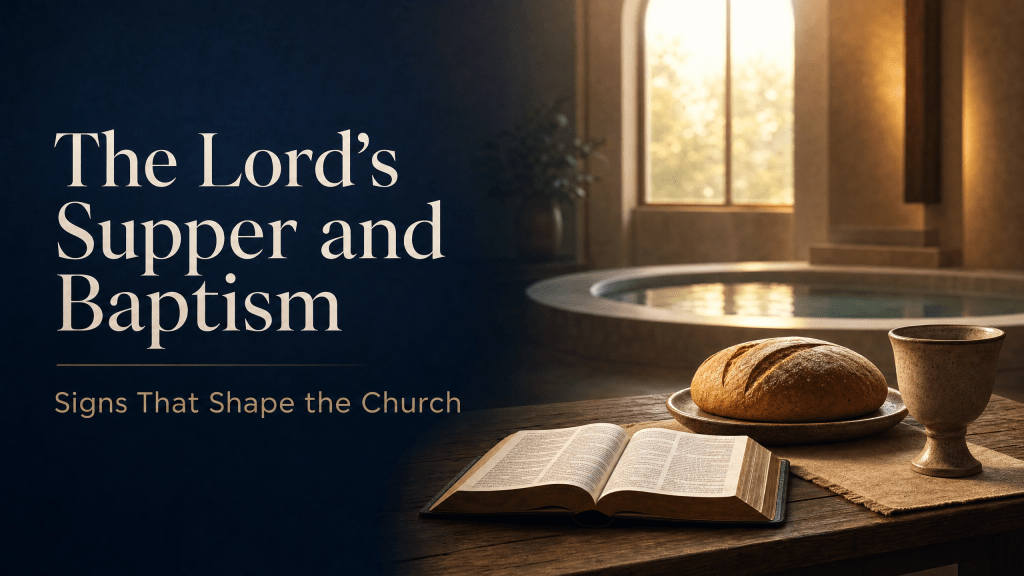
Early Sunday morning, Pastor Joel stood behind the communion table. The sanctuary was still quiet. Bread rested under a white cloth. The cup waited beside it. Near the front, a baptismal pool shimmered under soft light.
A young couple would be baptised that morning. Later, the church would come to the table. Pastor Joel had led both moments many times, yet that morning felt weighty. He whispered, “Lord, help us see what these signs truly mean.”
Many Christians know baptism and communion so well that familiarity can soften wonder. Yet Scripture presents them not as empty rituals, but as sacred signs given by Jesus to shape His people.
More Than Religious Routine
Baptism is a public declaration of faith, a sign of cleansing, new life, and union with Christ in His death, burial, and resurrection. Jesus commanded His church to make disciples and baptise them (Matthew 28:19).
Communion, also called the Lord’s Supper, is a shared meal of remembrance, thanksgiving, proclamation, and fellowship. Jesus took bread and said, “Do this in remembrance of Me” (Luke 22:19).
These are commands of Christ, entrusted to the church until He returns.
Baptism: The Waters of Belonging
Baptism makes invisible grace visible. In water, the believer testifies: I belong to Jesus. Paul writes that those baptised into Christ are united with His death and raised to walk in newness of life (Romans 6:3-4).
Baptism is not graduation for perfect Christians. It is a beginning. It announces repentance, faith, cleansing, new identity, and entrance into God’s visible community.
Denominations differ in practice. Baptist, Pentecostal, and many Evangelical churches usually practise believer’s baptism by immersion. Anglican, Methodist, Catholic, and many Reformed churches baptise infants, often connecting baptism to covenant family and later confirmation. Orthodox churches often practise triple immersion, including infants.
These differences are shaped by covenant, original sin, personal confession, tradition, and Christian family. Yet across traditions, baptism points to belonging to Christ.
Communion: The Table of Remembrance
At communion, the church gathers around Jesus’ sacrifice. We look back to the cross, around at the body, within through self-examination, and ahead to His return. Paul says that as often as we eat the bread and drink the cup, we proclaim the Lord’s death until He comes (1 Corinthians 11:26).
Communion is not a private snack with religious meaning. It is a family table. Grace was costly, forgiveness was purchased, and the church is one because Christ gave Himself for us.
Christians differ over what happens in communion. Catholic teaching speaks of transubstantiation, where bread and wine become Christ’s body and blood. Orthodox churches speak of mystery and real presence. Lutheran theology speaks of Christ present in, with, and under the elements. Anglican and Reformed traditions often emphasise spiritual presence and nourishment by faith. Baptist and many Evangelical churches emphasise memorial remembrance.
These differences came through centuries of prayer, Scripture, tradition, and Reformation debate. The disagreement is real, but the centre remains clear: the table points us to Christ crucified, risen, present with His people, and coming again.
Frequency, Reverence, and Faithfulness
How often should these signs be practised? Scripture commands baptism when disciples are made, and communion as the church gathers, but gives no required schedule.
Some churches receive communion weekly. Others do so monthly or on special services. Some baptise whenever a believer is ready. Others use classes or confirmation.
The goal is not frequency. A weekly table can become routine. A monthly table can become casual. A baptism can become performance. God desires faithfulness, reverence, understanding, unity, and joy.
What God Actually Wants
Baptism and communion are not boxes to tick. They are gifts that preach the gospel to our bodies. Water touches skin. Bread is broken. The cup is received. The church does not only hear the gospel; it sees, tastes, and embodies it. These actions must be done conciously and by believers who understand the gravity of what it represents. Baptism and communion are public declaration of affiliation to Jesus.
God wants these signs to be Christ-centred, communal, faith-filled, reverent, unified, and obedient. They are not meant to divide believers into proud camps, but to pull our eyes back to Jesus.
So when Pastor Joel lifted the bread and later stood by the water, he did not see routine. He saw grace made visible. The church was reminded who saved them, joined them together, and calls them to walk in new life.
Reflection Questions
1.How did your church tradition shape your understanding of baptism and communion?
2.Do you approach these practices with reverence or routine?
3.What does baptism say about your identity in Christ?
4.How does communion shape your memory of the cross and your unity with others?
5.What might God be inviting you to rediscover in these sacred signs?
Prayer
Lord Jesus, thank You for giving Your church baptism and the Lord’s Supper. Teach us to receive these signs with reverence, joy, faith, and understanding. Keep us centred on Your death, resurrection, and return. Unite Your people across traditions, and let these gifts draw us deeper into Your grace. Amen.

 Devotional
Leave a comment