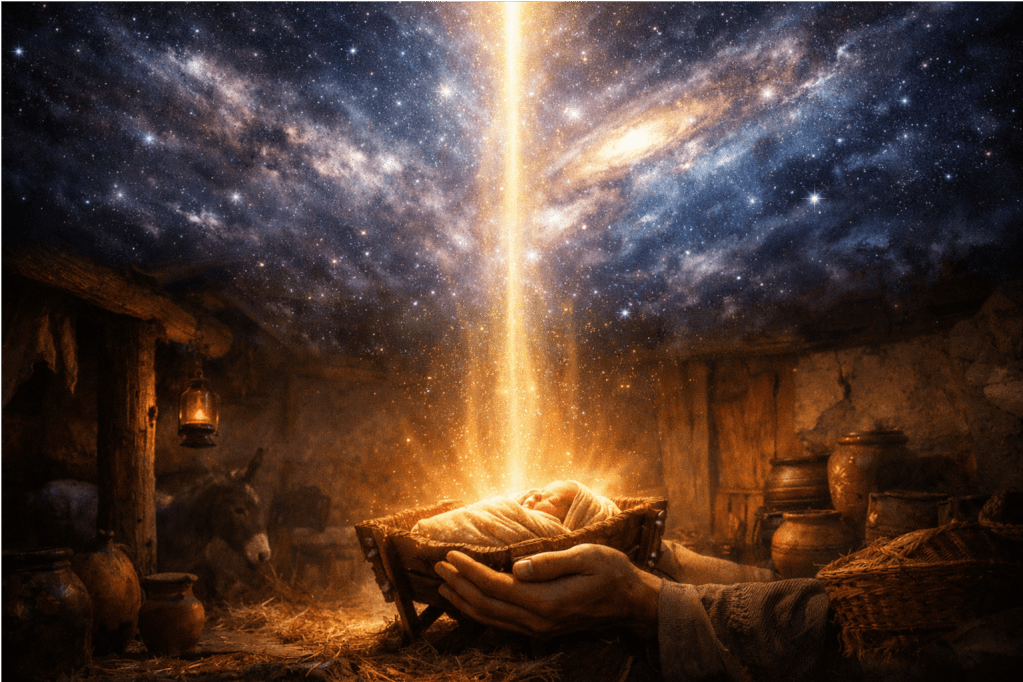
Scripture Focus: John 1:14 | Philippians 2:6-8 | Hebrews 2:17-18 | John 14:9
“And the Word became flesh and dwelt among us, and we have seen his glory, glory as of the only Son from the Father, full of grace and truth.”— John 1:14
The Mystery of the Dark Room: A Father’s Love
Little Maya was terrified of the dark. Every night, as soon as the lights went out, her small room changed. It transformed into a cavern of unseen monsters. Whispering shadows filled the space. Her father, a kind and patient man, would sit on the edge of her bed, trying to explain away her fears. “There’s nothing there, sweetie. It’s just your imagination.” He’d point to the window, showing her the familiar shapes of trees outside, now silhouetted against the moonlight. He’d tell her stories of brave knights and friendly creatures.
But the fear remained. One night, as Maya sobbed uncontrollably, her father did something different. Instead of trying to explain the dark away, he simply lay down beside her, pulling the covers over himself. He didn’t turn on a light. He didn’t offer more logical explanations. He just entered her dark, terrifying world. He whispered, “I’m here, Maya. You’re not alone.” And in that shared darkness, in the warmth of his presence, Maya’s fear began to recede. The monsters didn’t disappear. However, they lost their power. Her father, strong and loving, had become one with her in her fear.
This simple act of a father entering his child’s fear-filled world offers a glimpse into the profound mystery we call the Incarnation. It is the moment the eternal God stepped into time. The invisible God became visible, and the Creator entered creation. It’s where the infinite fit inside the finite, and the One who holds the universe together was held in a mother’s arms. Let’s walk slowly, reverently, and clearly into this mystery, for it is the heart of God’s love.
1. The Incarnation: God Adding, Not Subtracting
Many mistakenly imagine the Incarnation as God shrinking Himself, reducing His divinity, or somehow ceasing to be God. But Scripture paints a far more magnificent picture. It declares:
“The Word became flesh and dwelt among us.” – John 1:14; “[Jesus], though he was in the form of God, did not count equality with God a thing to be grasped, but emptied himself, by taking the form of a servant, being born in the likeness of men.” – Philippians 2:6-7
Here’s the mystery: Jesus did not subtract divinity; He added humanity. He didn’t stop being what He was (fully God); He became what He was not (fully man). He is fully God and fully man, one Person with two distinct natures. Not blended, not diluted, not half-and-half. A king does not cease to be a king when he puts on the clothes of a servant. The king does this to understand his people. In the same way, Jesus did not cease to be God. He simply added the experience of being human, bridging the infinite chasm between Creator and creation.
2. God Stepping Into Our Condition, Not Just Our World
The Incarnation is more than God simply visiting Earth. It’s God stepping into the human condition. Jesus didn’t just walk where we walk; He felt what we feel. He experienced:
- Hunger (Matthew 4:2)
- Fatigue (John 4:6)
- Loneliness (Matthew 26:40)
- Temptation (Matthew 4:1-11)
- Grief (John 11:35)
- Pain (Matthew 27:27-31)
- Tears (Luke 19:41)
As the book of Hebrews profoundly states:
“He had to be made like his brothers in every respect, so that he might become a merciful and faithful high priest in the service of God, to make propitiation for the sins of the people. For because he himself has suffered when tempted, he is able to help those who are being tempted.” – Hebrews 2:17-18
Imagine a doctor who doesn’t just diagnose from a distance. He steps into the hospital bed, takes on the disease, and absorbs it into himself to cure the patient. That is the Incarnation. God did not save us from the outside; He stepped inside the human condition to heal it from within. He knows our struggles intimately because He lived them.
3. The Marriage of Heaven and Earth: A Union of Love
The Incarnation is not just a miracle; it is a sacred union – a marriage of heaven and earth in one Person. Divinity and humanity meet in one body. The eternal and the mortal meet in one life. Think of a blacksmith’s iron, heated in the forge. The iron does not stop being iron, and the fire does not stop being fire. But the iron glows with the fire’s heat and light, becoming an extension of its power.
In Jesus, humanity glows with divinity – not because it becomes divine, but because God unites Himself to it. This unique union is why Jesus can:
- Forgive sins (only God can do that – Mark 2:7)
- Die (only humans can do that – Mark 15:37)
- Rise (only God can do that – Acts 2:24)
- Sympathize with us (only a human can do that – Hebrews 4:15)
The Incarnation makes the cross possible. The Incarnation makes resurrection meaningful. The Incarnation makes salvation personal. It is the ultimate expression of God’s desire for intimate relationship with us.
4. The Incarnation: God Coming Close Enough to Be Killed
This is the part we often overlook, especially as we approach Easter. God became human so He could die. Not metaphorically, not symbolically, but literally. The eternal God took on a body, so that body could be broken. The immortal God took on mortality so He could conquer death from the inside. The infinite God took on flesh so that flesh could be nailed to a cross.
The Incarnation is not sentimental; it is profoundly sacrificial. It is God saying, “I will not save you from a distance. I will save you from within your suffering, even if it means entering death itself.” It is the ultimate act of solidarity, paving the way for our redemption.
5. The Incarnation: The Ultimate Revelation of God’s Love
If you want to know what God is truly like, you don’t look first at creation, or miracles, or commandments. You look at Jesus.
“Anyone who has seen Me has seen the Father.” – John 14:9
“He is the radiance of the glory of God and the exact imprint of his nature.” – Hebrews 1:3
The Incarnation is God saying, “This is My heart. This is My character. This is My love – up close, in person, in flesh.” It is the clearest, most tangible demonstration of a God who cares deeply. He would bridge every gap and endure every pain. He becomes one of us to bring us back to Himself.
A Moment to Pause and Reflect
Where does the Incarnation meet you today? In your confusion, God became understandable. In your weakness, God became touchable. In your suffering, God became vulnerable. In your sin, God became Savior. In your humanity, God became human.
The Incarnation is not merely a doctrine to memorize. It is a miracle to behold. It is a mystery to worship. It is a love to receive. Because the God who came near is the God who will walk to the cross. And the God who walks to the cross is the God who will rise again, conquering death for all who believe.
Prayer
Almighty God, we stand in awe of the profound mystery of the Incarnation. Thank You for loving us so deeply that You would become one of us, entering our human experience, our pain, and our darkness. Open our hearts to grasp the depth of Your sacrifice and the intimacy of Your presence. As we journey toward Easter, may the truth of Your Incarnate love transform us, making us more like You. Amen.
This Week’s Practice
This week, choose one aspect of Jesus’ humanity (e.g., His hunger, His grief, His temptation) and meditate on it. How does knowing that God experienced this human reality change your perspective on your own struggles? Journal about how the Incarnation makes God more relatable and His love more tangible to you. Let this practice deepen your appreciation for the Son of God who became the Son of Man, preparing your heart for the ultimate sacrifice and triumph of Easter.
 Devotional
Leave a comment