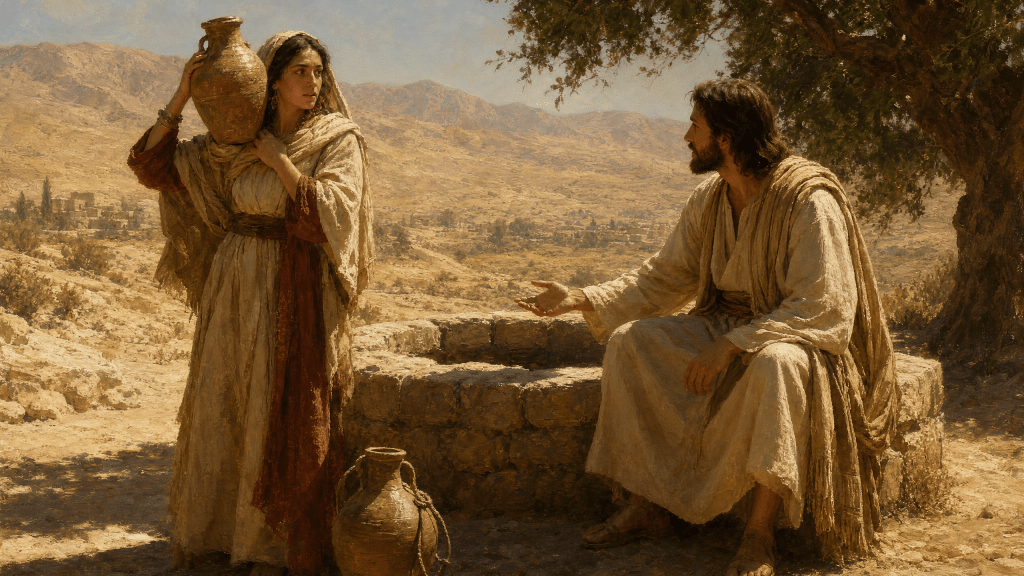
Text: John 4
Theme: Jesus meets us where we are, not where we pretend to be.
Her story begins with avoidance. She comes to the well at noon, the hottest, most punishing part of the day, exactly when she knows no one else will be there. Women normally draw water in the cool of the morning, gathering in groups, talking and laughing. But she comes alone.
She is exhausted by the whispers. Exhausted by the stares. Exhausted by the reputation that follows her like a heavy shadow. She has had five husbands, and the man she lives with now is not her husband. Her life is a long trail of broken relationships, broken trust, and fractured identity. She is the woman everyone in town talks about, but no one actually talks to.
She is running from her past. Yet the very place she goes to hide is the exact place Jesus chooses to meet her.
Grace Crosses the Boundary
Jesus sits by the well, tired from His journey. But He is not too tired to see her, speak to her, or cross every conceivable cultural, social, and moral boundary to reach her.
He asks her for water. She is stunned. Jews simply do not speak to Samaritans. Men do not speak to women alone in public. Rabbis certainly do not speak to women with her reputation. But Jesus is completely unbound by human protocol; He is moved entirely by divine purpose. He doesn’t wait for her to clean up her life or come to the synagogue. He meets her in her shame. He meets her in her hiding. He meets her in her daily routine.
Grace always goes first.
The Thirst Beneath the Thirst
Jesus tells her that if she knew who was speaking, she would ask Him for living water. She assumes He is talking about physical water, but Jesus is speaking to the thirst beneath the thirst. The desperate thirst for acceptance, love, stability, and belonging.
Then, gently, He exposes her truth: “You have had five husbands, and the man you now have is not your husband.”
He doesn’t shame her. He doesn’t condemn her. He doesn’t humiliate her. He reveals her deepest wound solely so He can heal her heart. Jesus is never afraid of our truth; He is drawn to it.
Entrusting the Revelation
Uncomfortable with the exposure, she tries to deflect. She tries to hide behind a theological debate about where people ought to worship. But Jesus cuts straight through the religious deflection to the core of the moment: “I am the Messiah.”
He reveals His true identity to her before He reveals it to the crowds, before He reveals it to the religious leaders, and before He reveals it plainly to His own disciples. The first person Jesus openly tells, “I am the Messiah,” is an ostracized woman with a broken past. He entrusts the greatest revelation in history to someone everyone else had rejected.
The Unlikely Evangelist
She leaves her water jar behind. That jar was the symbol of her daily struggle, her routine, and her shame.
She runs back into the very town she had been actively avoiding. She runs directly to the people she had been hiding from. She runs with a message she barely understands: “Come see a man who told me everything I ever did.”
The woman who once avoided crowds now gathers them. The woman who lived in quiet shame now speaks with undeniable boldness. The outcast becomes a voice of revival. Scripture records that many Samaritans believed because of her testimony. The story she was most ashamed of became the exact story God used to save a city.
A Word to the Reader
Maybe you feel like the woman at the well. You have made mistakes you are not proud of. You carry shame quietly. You avoid certain places or people because of your past, wondering if God could ever use someone with your history.
Her story speaks directly to that fear. Jesus meets you exactly where you are. He sees you fully and loves you completely. Your past does not disqualify you. Your mistakes do not define you. Your brokenness does not limit God.
The very place you feel empty is the place He wants to fill. And the story you are most afraid to tell may be the exact story God intends to use to save someone else.
Prayer
Lord, meet me in the places I try to hide. Heal the wounds I carry quietly. Turn my shame into testimony and my emptiness into overflow. Use my story, every single part of it, to draw others to You. Amen.
 Devotional
Leave a comment