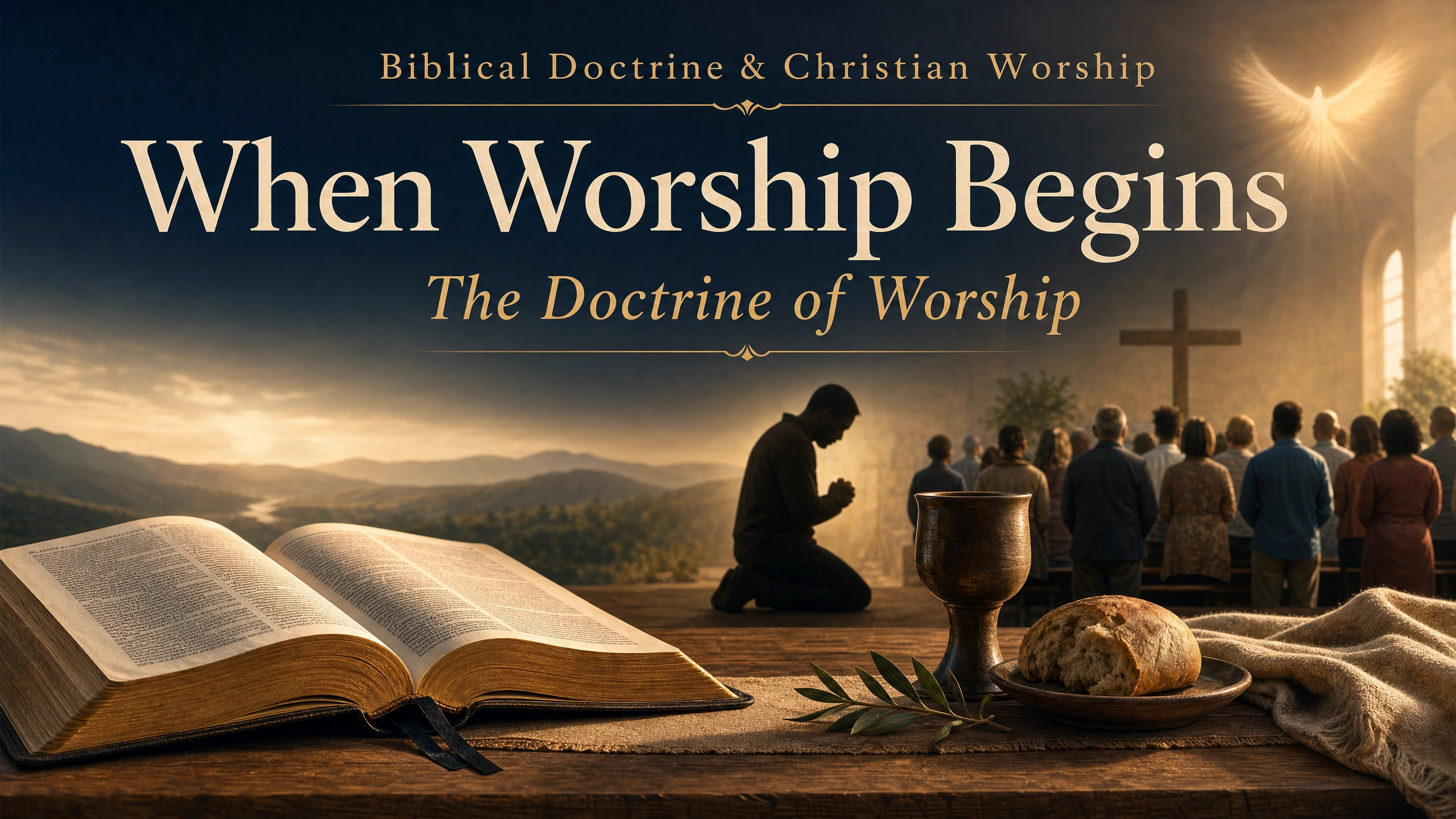
The Doctrine of Worship
The first sound of worship in the morning was not a song.
It was the soft crackle of firewood outside a shepherd’s tent, the bleating of sheep, and the slow breathing of a young man named Micah as he led his flock toward water. He was not a priest. He had no scroll in his hand. No choir followed him across the hills. His clothes smelled of dust, smoke, and animals.
Yet when the sun rose over the Judean hills and the stream caught the light, he stopped. The sheep lowered their heads to drink. The wind moved through the grass. Something in him became still.
He whispered, “Lord, You are here.”
That was worship. Worship began when his heart recognized the worth of God and turned toward Him.
Every conversation about worship must begin here. Before music, liturgy, preaching, icons, sacraments, offerings, posture, buildings, and style, worship begins with God revealing Himself and people responding with reverence, trust, surrender, and obedience.
Scripture gives us this pattern from the beginning. Abel brought an offering by faith. Noah built an altar after the flood. Abraham raised altars in unfamiliar places because God had spoken to him. Moses removed his sandals before the burning bush because the ground was holy. Isaiah did not begin with a song when he saw the Lord high and lifted up. He began with trembling: “Woe is me” (Isaiah 6:5).
Worship is never casual when God is seen clearly.
The Bible does not reduce worship to one expression. Sometimes worship looks like sacrifice. Sometimes it looks like silence. Sometimes it is a song of joy, as in the Psalms. Sometimes it is obedience when obedience is costly. Samuel told Saul, “To obey is better than sacrifice” (1 Samuel 15:22). Paul later gathered all of life into one altar call: “Present your bodies as a living sacrifice” (Romans 12:1).
So worship is not first about what we do with our hands. It is about what has happened to the heart. Jesus made this plain when He spoke to the Samaritan woman at the well. The debate of her day was about location. Should people worship on this mountain or in Jerusalem? Jesus answered by moving the question deeper: “The true worshippers will worship the Father in spirit and truth” (John 4:23).
Spirit without truth becomes emotion without anchor. Truth without spirit becomes form without life.
History shows how often the church has returned to this centre. The earliest Christians met in homes, breaking bread, praying, receiving the apostles’ teaching, and sharing life together (Acts 2:42). Their worship was simple, but not shallow. As the church grew, gatherings became more structured. Prayers were written down. Creeds were confessed. Psalms were chanted. Buildings were shaped for teaching, sacraments, and reverence. Later, reformers stripped worship back, fearing that signs had begun to distract from the Saviour.
Those changes did not happen in a vacuum. They grew from real questions. How do we honour a holy God? How do we teach the faith? How do we keep worship biblical? How do we protect the church from empty ritual and careless novelty?
Those questions still matter.
An Anglican kneeling in confession, a Pentecostal lifting hands, a Baptist opening Scripture, an Orthodox believer venerating an icon, and a mother washing dishes while praying may look very different. We must test every practice by Scripture. Yet we must also remember that the heart of worship is not style. It is surrender to the living God.
A church can have excellent music and still miss worship. A church can have ancient prayers and still miss worship. A preacher can explain doctrine and still miss worship. We miss worship whenever God becomes a tool for our preferences instead of the holy One before whom we bow.
The doctrine of worship begins here: God is holy, God has drawn near, God has redeemed His people, and God is worthy of the whole life.
Before we ask how worship should look, we must ask who worship is for.
It is for the Father, through the Son, by the Spirit.
And when the heart truly sees Him, worship has already begun.
Reflection Questions
1.Where do you most easily recognize God’s presence in ordinary life?
2.Which worship expression do you prefer, and what has shaped that preference?
3.Have you ever judged another believer’s worship style too quickly?
4.What would it mean this week to offer your body as a living sacrifice?
5.Is there any part of your life where God is asking for obedience, not just expression?
Prayer
Father, teach me to worship You with a truthful heart and a surrendered life. Deliver me from empty form and shallow emotion. Let Scripture shape my worship, let the Spirit awaken my love, and let Jesus remain at the centre of all I bring. Make my work, words, choices, and hidden obedience pleasing to You. Amen.
Leave a Reply