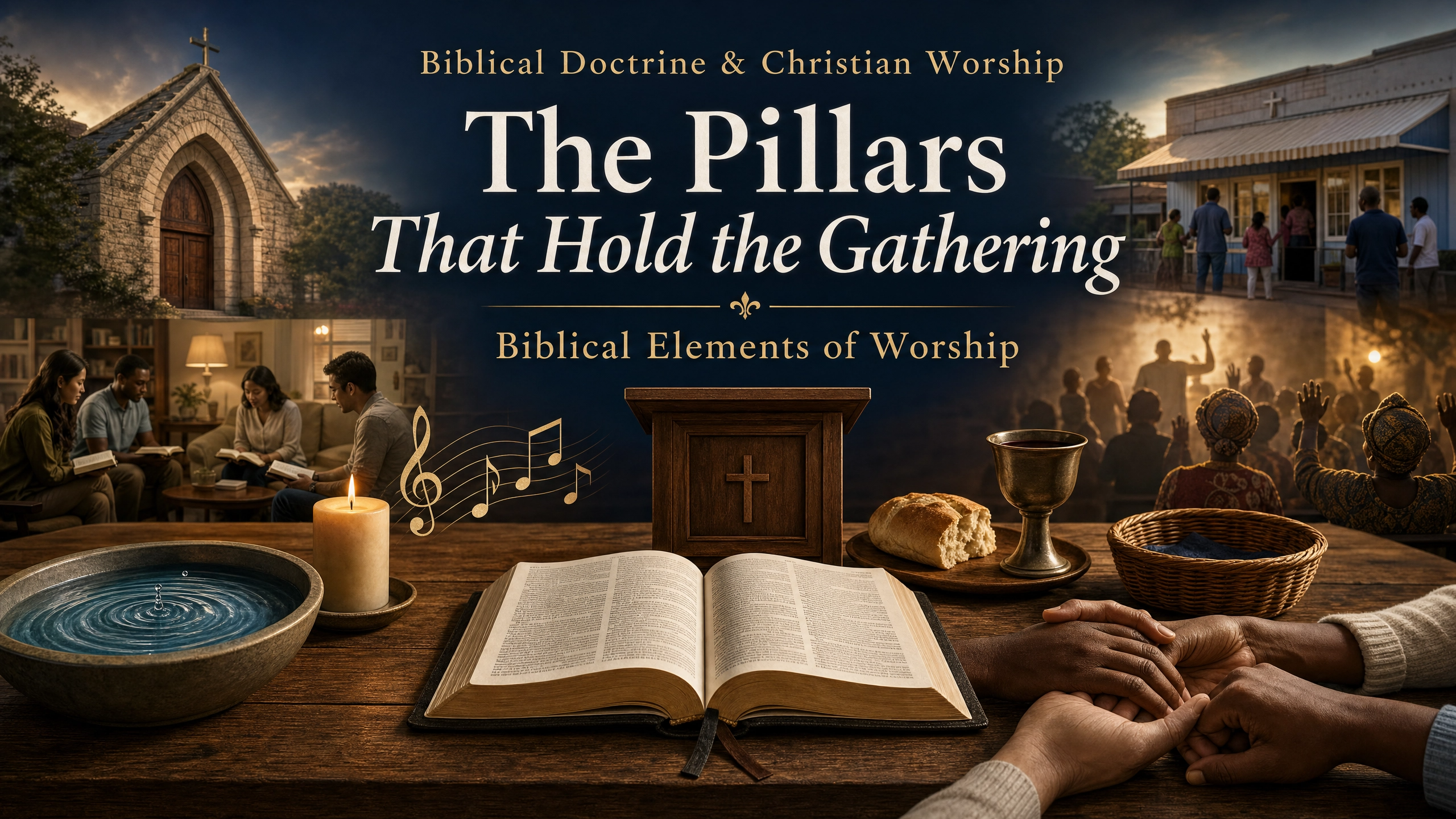
Biblical Elements of Worship
Amara noticed it first in London.
The Anglican church was quiet before the service began. A reader stepped forward, opened the Bible, and the congregation stood for the Gospel. Later, the people prayed words older than any of them. Bread and cup were lifted with care. No one rushed.
Months later, in Lagos, she stood in a Pentecostal church where prayer rose like a storm. People sang with their whole bodies. Scripture was quoted between songs. The offering moved through the room with dancing and thanksgiving.
In New York, she visited a Baptist church where the sermon carried the morning. The pastor read the text, explained it, pressed it into daily life, and the people listened with open Bibles.
Then in Kingston, after a Church of God service, people remained long after the final song. They embraced, testified, prayed for one another, and shared food outside.
Different rooms. Different sounds. Different histories.
Yet in any chirch gathering, the same pillars kept appearing.
The first pillar is Scripture. God’s people gather because God has spoken. Moses read the Law to Israel (Deuteronomy 31:11). Ezra opened the book and explained it (Nehemiah 8:8). Paul told Timothy to give attention to public Scripture reading (1 Timothy 4:13). That is why Anglican and Catholic churches use lectionaries, Reformed and Baptist churches centre preaching, and Pentecostal churches weave Scripture into prayer and song. Worship begins with listening.
The second pillar is prayer. Jesus called the temple “a house of prayer” (Matthew 21:13). The early church devoted itself to prayers (Acts 2:42). Some traditions pray written collects. Others offer pastoral prayers. In many African, Caribbean, and Pentecostal settings, the congregation prays aloud together. Prayer is the church breathing before God.
The third pillar is singing. “Sing to the Lord a new song” is a repeated command in the Psalms. Paul tells the church to sing psalms, hymns, and spiritual songs (Colossians 3:16). One church chants, another sings hymns with an organ, another uses gospel choir harmonies, and another worships with drums and call and response. Culture shapes the sound, but Scripture shapes the purpose.
The fourth pillar is preaching and teaching. When Ezra read the Law, the Levites gave the meaning (Nehemiah 8:8). Jesus taught in synagogues. Paul reasoned from the Scriptures. Preaching is not a motivational speech with verses attached. It is the ministry of the Word, calling people to faith, repentance, comfort, and obedience. A Catholic homily may be brief. A Baptist sermon may be longer and expository. A Pentecostal sermon may move with testimony. The preacher must remain under Scripture.
The fifth pillar is baptism and the Lord’s Supper. Jesus commanded baptism in the Great Commission (Matthew 28:19) and gave the meal with the words, “Do this in remembrance of me” (Luke 22:19). Christians disagree on meaning, method, and frequency. Some receive Communion weekly, others monthly. Some baptize infants, others believers by immersion. These differences matter, but both practices point the church back to Christ.
The sixth pillar is giving. Israel brought offerings before the Lord, and the New Testament calls believers to generosity that is willing, cheerful, and sincere (2 Corinthians 9:7). In some churches the offering is quiet. In some Nigerian and Caribbean churches, people dance forward with thanksgiving. The danger is manipulation. The beauty is gratitude. Giving is worship when it says, “Lord, all I have is Yours.”
The seventh pillar is fellowship. Acts 2:42 joins teaching, bread, prayers, and fellowship together. The church is not an audience watching sacred activity. It is a family being formed. Tea after Anglican worship, Baptist Sunday school, Orthodox feasts, Pentecostal testimonies, small groups, hospitality, and meals become holy when believers carry one another in Christ.
Amara wrote one sentence in her notebook that evening: “The form travels through culture, but the foundation comes from Scripture.”
That is the practical question for every church and every believer. Do our gatherings give God room to speak through Scripture, receive our prayers, fill our songs with truth, correct us through preaching, centre us at baptism and the Table, teach generosity, and bind us as family?
If not, we may have activity without formation.
But when these pillars stand, worship becomes more than a service. It becomes a people shaped by God.
Reflection Questions
1.Which pillar of worship is strongest in your church tradition?
2.Which pillar needs to be recovered or strengthened in your own life?
3.How has your culture shaped the way you pray, sing, give, or fellowship?
4.Are there biblical practices you have treated as optional because they feel unfamiliar?
5.What would it look like to come to worship ready to listen, respond, give, and belong?
Prayer
Father, thank You for giving Your church practices that form us in truth and love. Teach me to listen when Scripture is read, pray with sincerity, sing with understanding, receive Your Word with humility, honour baptism and the Table, give with joy, and live in fellowship with Your people. Let my worship be biblical, grateful, and alive in Christ. Amen.
Leave a Reply