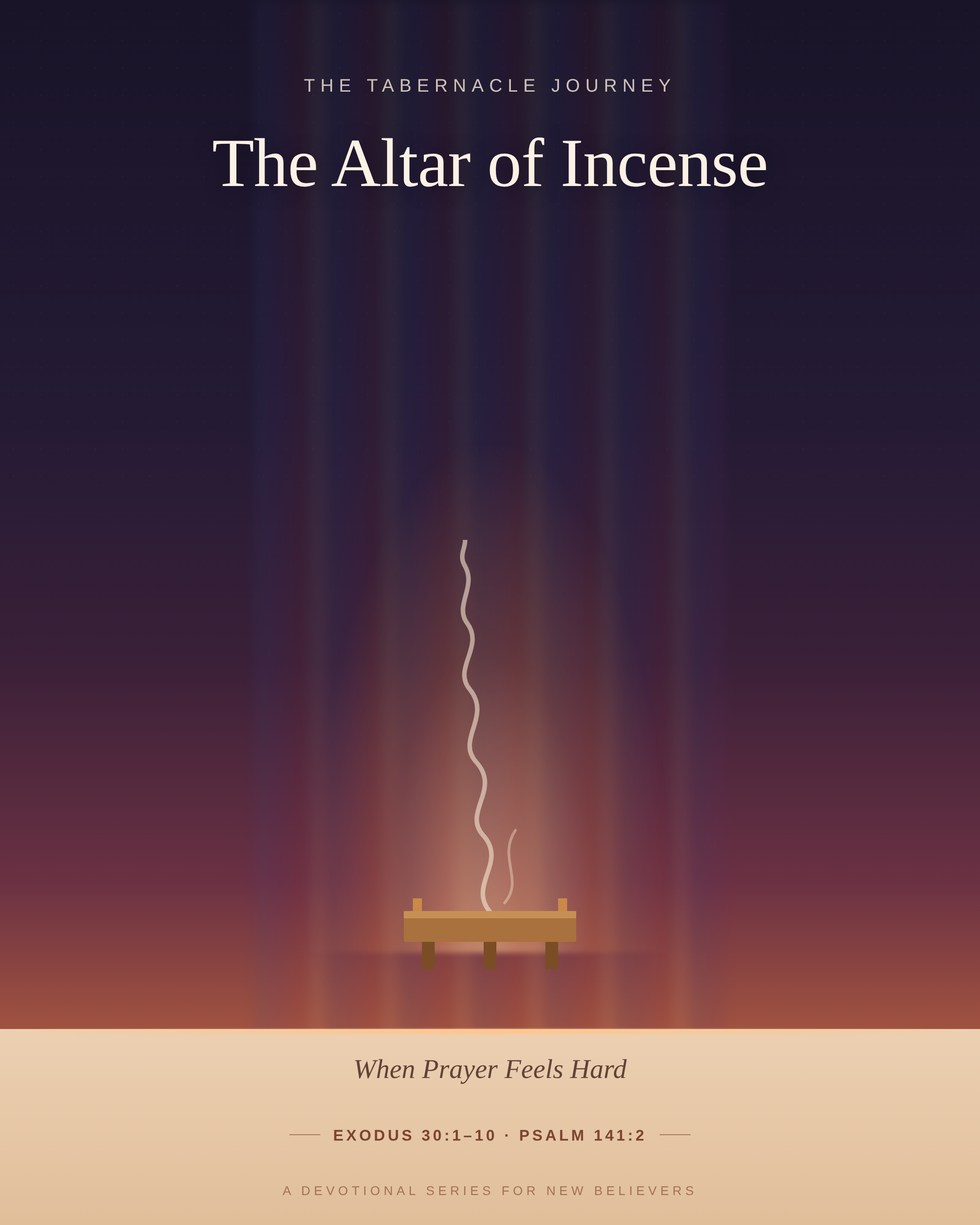
Of everything inside the Tabernacle, one piece of furniture stood closer to God’s presence than almost anything else. The Altar of Incense, positioned directly in front of the veil, close enough that its smoke would have drifted right up against the curtain separating the Holy Place from the very presence of God.
That placement was not an accident. It tells you something about what prayer actually is, and where it actually leads.
What the Altar of Incense Actually Was
The Altar of Incense stood just before the veil, and it was used every single morning and every single evening without exception (Exodus 30:1-10). Not when the priest felt spiritually strong. Not on the days inspiration showed up. Every time, on schedule, regardless of how anyone felt walking up to it.
The incense burned there was not something you could buy or blend yourself. God gave a specific recipe for it in Exodus 30:34-36, and He set it apart for this one purpose alone. It could not be used for anything ordinary. This was not background scent. It was something made specifically to rise, specifically toward Him.
Here is what all of that teaches us. Prayer is rhythm…devotion….faithfulness. And prayer, done consistently, is set apart. It is not just another activity competing for space in your day. It is something made for one purpose.
Prayer as Fragrance
Scripture ties incense directly to prayer more than once, and the picture it paints is worth slowing down on. “Let my prayer be set before you as incense” (Psalm 141:2, NIV). Later, in Revelation, the prayers of God’s people are described the same way, incense rising before Him (Revelation 5:8, NIV).
Think about what incense actually does. It does not need to be loud to fill a room. It does not need to be seen to be noticed. It simply rises, steadily, and it changes the atmosphere around it without announcing itself. That is exactly what your prayer does, even the prayers you would never call impressive.
This is why placement mattered so much. The altar sat right before the veil, closer to the innermost presence of God than the lampstand or the table. Prayer was never meant to be one more item on a spiritual checklist. It was built to be the thing that brings you nearest to Him, the last step before the deepest place of all.
Why the Rhythm Matters More Than the Feeling
Here is the part easy to miss if you only think about prayer as something you do when you feel moved to. The priest did not wait for inspiration before lighting the incense. He came morning and evening, on a fixed rhythm, because the incense was never meant to depend on his emotional state that day.
This is genuinely good news, especially on the mornings prayer feels dry or distracted or difficult to begin. The altar was never asking the priest to feel a certain way first. It was asking him to show up. Twice a day, without fail. The fragrance rose whether he felt close to God that morning or not, because the rising never depended on him. It depended on faithfulness to the rhythm.
I know a couple who learned this firsthand. They began praying together each night, though only one of them felt confident in what they believed. The first few nights felt a little awkward. One prayed out loud. The other listened quietly. But they kept the prayers short and sincere. “Lord, give us peace.” “Father, help us tomorrow.” No pressure, no performance, just the rhythm repeated night after night.
Over time, without either of them making it dramatic, their home grew steadier. Conversations grew more honest. The rhythm itself did the work that no single powerful moment could have done. That is the Altar of Incense in an ordinary home….just steady fragrance, rising on schedule, regardless of how confident anyone felt saying the words.
Building Your Own Rhythm
You do not need eloquent language to begin. The priests did not burn a mountain of incense, just enough to rise. A short, honest sentence works the same way. “Lord, help me.” “Father, be near.” “God, strengthen me.” Consistency grows out of simplicity, not the other way around.
Try echoing the altar’s own pattern from Exodus 30:7 to 8: pray morning and evening. It does not have to be long or eloquent, just steady. When your own words run dry, let Scripture pray for you instead. Psalm 23, Psalm 27, Psalm 46, or the Lord’s Prayer in Matthew 6:9-13 can all carry you on the days your own words will not come.
And let prayer weave into the ordinary shape of your day rather than living only in a formal sitting. Before a meeting. During a walk. While cooking. This is what Paul meant by praying without ceasing (1 Thessalonians 5:17). Small and constant, rising the way incense rises, without needing to be loud to matter.
Sit With This for a Moment
- Does your prayer life depend on how you feel that day, or does it run on rhythm the way the altar did?
- What would change if you treated prayer as something set apart, made for one purpose, rather than one more task competing for your attention?
- What is one honest sentence you could offer, morning and evening, starting tomorrow?
A Prayer to Make This Your Own
Lord, teach me to pray with rhythm, not just emotion. Let my prayer rise before You like incense, morning and evening, whether I feel strong or weak that day. Set my heart apart for this, the way the altar was set apart. Draw me nearer to Your presence through it. Amen.
This Week’s Practice
Every morning and evening, pray one sincere sentence. Just one, offered honestly, on the same rhythm the altar kept.
Let this be your incense.
Leave a Reply