Series: The Making of a King – The Life of David
Twice in this stretch of David’s life, Saul is completely at his mercy. Not almost. Completely. One word from David’s men, one movement of his hand, and the man who has been hunting him for years would be dead – and the throne he had been promised anyway would be his immediately.
David doesn’t do it. Not once. Not twice. And the reason why might be a massively important lesson in his entire life.
The Scene: 1 Samuel 24 and 26
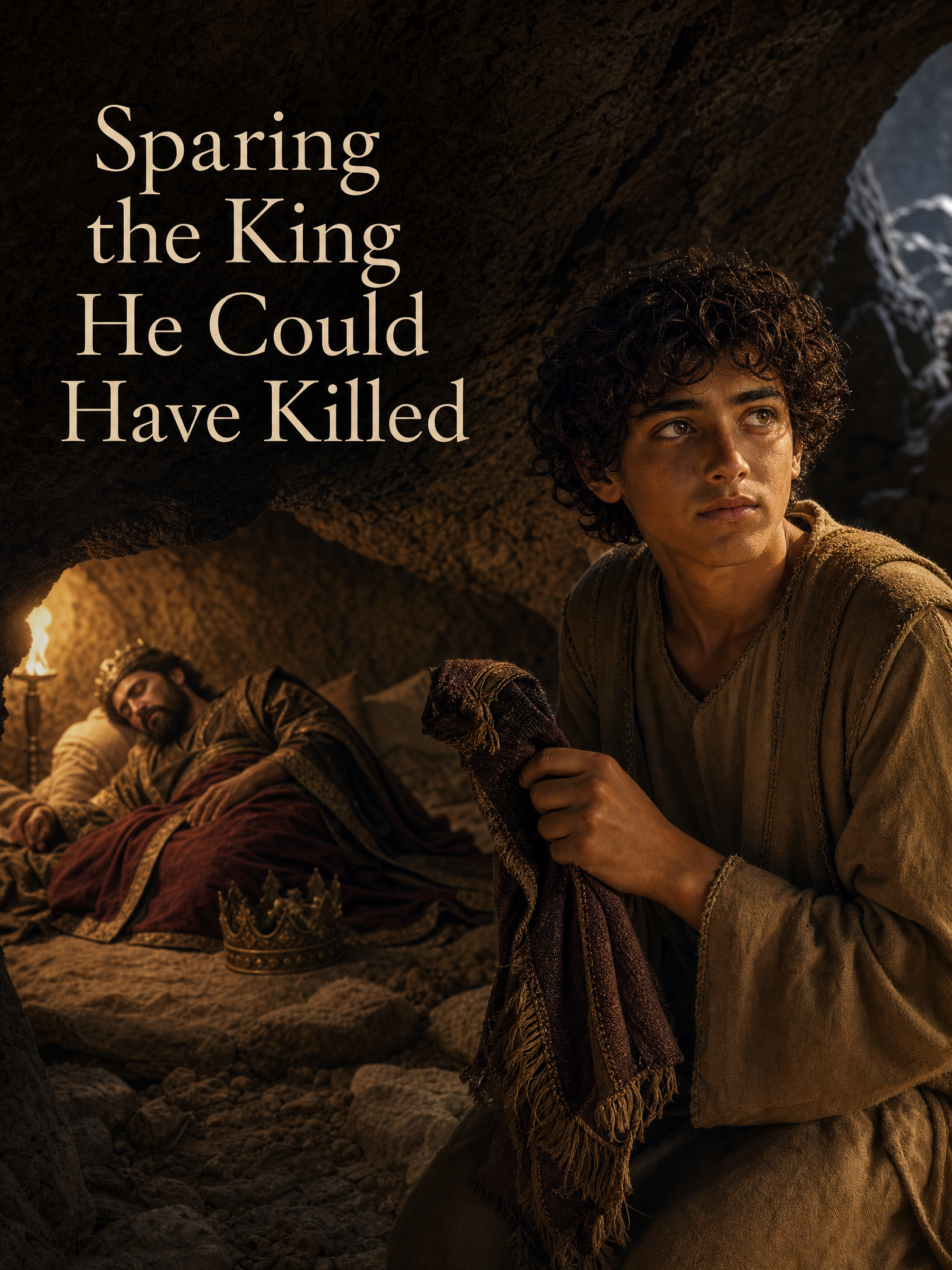
The first time, Saul walks into the cave alone at En Gedi. David and his men are hiding here, and Saul was unaware. David’s men whisper what feels obvious: “Here is the day of which the LORD said to you, ‘Behold, I will give your enemy into your hand.’” (1 Samuel 24:4)
David creeps forward and cuts off a corner of Saul’s robe. That’s all. And even that small act troubles him:
“David’s heart struck him, because he had cut off a corner of Saul’s robe… ‘The LORD forbid that I should do this thing to my lord, the LORD’s anointed, to put out my hand against him, seeing he is the LORD’s anointed.’” (1 Samuel 24:5–6)
The second time, in chapter 26, David sneaks into Saul’s camp at night while everyone sleeps. His companion Abishai wants to end it with one thrust of a spear. Again, David refuses:
“Do not destroy him, for who can put out his hand against the LORD’s anointed and be guiltless?” (1 Samuel 26:9)
Two open doors. Two opportunities most people would call gifts from God. And David walks through neither of them.
Why David Refused to Kill Saul
It’s worth asking what was actually holding David back, because it wasn’t fear and it wasn’t weakness. A few things seem to be happening in him at once.
- He feared God more than he feared Saul. David understood that authority is something God gives, not something an opportunity hands you. Saul being defenseless in a cave didn’t change who had put Saul there in the first place.
- He refused to become what he was fleeing. If David had killed Saul in that moment, he would have become a version of Saul – a king who reached for violence to secure his own position. The very thing he was running from would have become the thing he built his throne on.
- He trusted God’s timing more than his own strategy. David seems to have understood something many of us resist: destiny is meant to be received, not seized. He had a promise. He didn’t have permission to force its arrival.
- He valued the process as much as the position. A throne gained through a corrupted heart wouldn’t have been worth having. David seemed to sense that how he got there would matter just as much as whether he got there at all.
- He understood what covenant loyalty actually meant. Saul was deeply flawed – jealous, unstable, dangerous. But he was still God’s anointed. David’s respect wasn’t for the man; it was for what God had placed on him.
Underneath all five of these is one simple, sobering truth: you cannot use sin to accomplish God’s promise. The promise doesn’t need help arriving through the wrong means.
Restraint Is a Form of Worship
Here’s the reframe worth sitting with. David’s refusal to kill Saul wasn’t just restraint for restraint’s sake. It was worship.
Every time he lowered his hand instead of raising it, he was saying something to God without needing any words. I trust Your timing. I trust Your justice. I trust Your process. I trust Your promise.
Restraint, looked at this way, is faith expressed through patience. It’s worship expressed through obedience. It’s courage expressed through self-control. Most of us think of worship as something we sing. David’s cave shows us it can just as easily be something we refuse to do.
Pastoral Insight: Not Every Opportunity Is From God
Notice how David’s own men framed the moment in the cave – as if the circumstance itself proved it was God’s will. It sounded spiritual. It wasn’t. And David’s response teaches something worth carrying into our own lives.
Opportunity is not always divine. Access is not always permission. Advantage is not always an assignment. And timing isn’t automatically right just because the circumstances happen to line up in your favor.
Sometimes God lets you stand close enough to your destiny to touch it – not so you’ll take it, but to see whether you’ll wait for Him to give it to you instead.
Trusting God With the Outcome, Not Just the Promise
David already knew he was going to be king. Samuel had anointed him for exactly that. The temptation in these chapters was never doubting the promise, it was trying to control how and when it arrived.
David’s response stayed remarkably simple both times. He did what he knew was right in front of him, and then he left what he couldn’t control in God’s hands.
“The LORD judge between me and you, and the LORD avenge me against you, but my hand shall not be against you.” (1 Samuel 24:12)
Reflection Questions
- Has an opportunity ever presented itself that felt like “God opening a door,” but actually required you to compromise something you knew was right?
- Of David’s five reasons for restraint, which one speaks most directly to a decision you’re facing right now?
- Where are you trying to control an outcome that actually belongs to God, either through timing, strategy, or force?
A Prayer for Restraint
Lord, teach me the difference between an open door and Your invitation. Give me the discipline to hold back when holding back is right, even when acting feels justified. Help me fear You more than I fear my circumstances, and trust Your timing more than my own strategy. Let restraint be my worship when action would be my sin. Keep my hands clean, even when clean hands cost me something. Judge between me and anyone who wrongs me; that was never mine to do anyway. Amen.
Closing Thought for the Episode
David had every justification, every opportunity, and every reason most people would accept to take Saul’s life. He had none of the desire to actually do it, because he understood something many of us are still learning – that trusting God with a promise means trusting Him with how it arrives too.
Leave a Reply