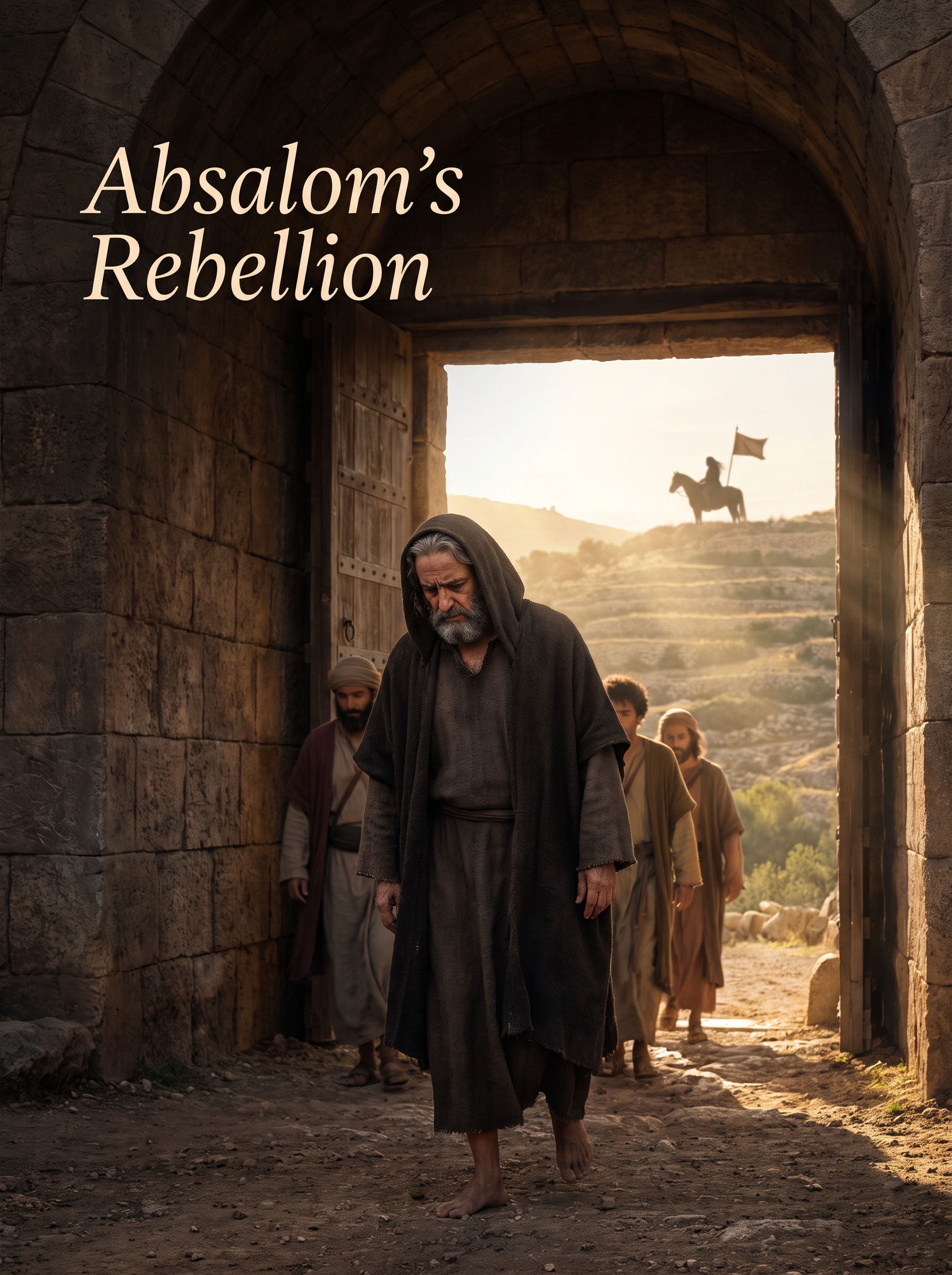
Series: The Making of a King – The Life of David
David once stood in a cave with Saul’s life in his hands and refused to take it, trusting God with the timing of his own throne. Years later, David finds himself on the other side of that exact test – fleeing Jerusalem barefoot, weeping, driven out by his own son. The throne he once refused to seize by force is now being taken from him by force, and he has to decide, all over again, whether he still trusts God with what happens next.
This devotional is less about Absalom’s betrayal and more about what David does with it – how a man leads, grieves, and stays humble when the crown itself is being stripped away.
The Scene: 2 Samuel 15–18
Absalom’s rebellion happened over years. He would position himself at the city gate, intercepting people who’ve come to David for justice, telling each one their case is right but that there’s no one appointed to hear it:
“Absalom used to rise early and stand beside the way of the gate. And when any man had a dispute… Absalom would say… ‘Oh that I were judge in the land! Then every man with a dispute or cause might come to me, and I would give him justice.’… So Absalom stole the hearts of the men of Israel.” (2 Samuel 15:2–6)
It’s a slow, deliberate theft of a throne, not by force at first, but of loyalty by flattery. When Absalom finally declares himself king in Hebron, the conspiracy is strong enough that David has to flee his own capital:
“And a messenger came to David, saying, ‘The hearts of the men of Israel have gone after Absalom.’ Then David said to all his servants who were with him at Jerusalem, ‘Arise, and let us flee, or else there will be no escape for us from Absalom.’” (2 Samuel 15:13–14)
Stolen Loyalty Versus Given Loyalty
It’s worth pausing on how different this is from David’s own path to the throne. David was anointed by God and, years later, crowned when the elders of Israel came to him freely, on their own initiative (2 Samuel 5:1–3). Absalom takes a different route entirely – manufacturing loyalty through flattery, promising a justice he had no intention of delivering fairly, positioning himself as the answer to grievances he never actually solved.
Here lies a sharp contrast. Genuine leadership, the kind David modeled at his best, is received, not manufactured. Absalom’s rebellion is a case study in what it looks like when someone wants a position badly enough to counterfeit the trust that should have been earned honestly. David had waited years for a throne that was already promised to him. Absalom couldn’t wait even a season for one that wasn’t.
Trusting God More Than the Ark Itself
One of the most striking moments in David’s flight is easy to miss. The priests bring the ark of the covenant out of Jerusalem with him – the very presence of God, physically leaving with the fleeing king. David sends it back:
“Then the king said to Zadok, ‘Carry the ark of God back into the city. If I find favor in the eyes of the LORD, he will bring me back… But if he says, “I have no pleasure in you,” behold, here I am, let him do to me what seems good to him.’” (2 Samuel 15:25–26)
This is a remarkable act of humility. David could have used the ark as leverage, a visible symbol to rally support or convince his men that God was obviously on his side because the ark was in his camp. He refuses. He won’t use God’s presence as a political tool, even in the most desperate moment of his reign. His trust is in God Himself, not in what having a sacred object nearby might do for his cause.
Shimei’s Curse and David’s Restrained Response
As David flees, a man named Shimei runs alongside him, throwing stones and cursing him, blaming him for Saul’s downfall (2 Samuel 16:5–8). David’s commander Abishai wants to kill him on the spot. David’s answer echoes the restraint he once showed toward Saul, but now applied to an insult instead of a threat:
“If he is cursing because the LORD has said to him, ‘Curse David,’ who then shall say, ‘Why have you done so?’… It may be that the LORD will look on the wrong done to me, and that the LORD will repay me with good for his cursing today.” (2 Samuel 16:10, 12)
This is a man who, even at his lowest point – barefoot, exiled, humiliated in front of his own men – still refuses to grasp for control he doesn’t need to grasp for. He’d rather absorb an insult and leave the outcome to God than spend his energy defending his own dignity.
A Father’s Grief, Regardless of the Betrayal
The rebellion ends in battle, and Absalom is killed against David’s explicit order to deal gently with him (2 Samuel 18:5, 14–15). When the news reaches David, his response isn’t relief that the threat to his throne is over. It’s grief that breaks through every royal formality:
“And the king was deeply moved and went up to the chamber over the gate and wept. And as he wept, he said, ‘O my son Absalom, my son, my son Absalom! Would I had died instead of you, O Absalom, my son, my son!’” (2 Samuel 18:33)
This is one of the rawest moments in all of David’s story. His son had led an open rebellion, tried to take his throne, and put his life at risk. None of that erases the love of a father. David never stops being Absalom’s father, even after Absalom stopped acting like his son. His grief doesn’t ask whether it was politically appropriate. It simply pours out.
Pastoral Insight: Leading Without Needing the Title
Throughout this entire ordeal, David never behaves like a man desperately trying to hold onto power. He doesn’t manipulate the ark. He absorbs Shimei’s curse instead of silencing it by force. He grieves his enemy-son without needing anyone’s permission to feel what he feels. Even stripped of his crown and his capital, he’s still leading with humility, restraint, and honesty, because his identity was never actually built on the throne in the first place.
This is worth sitting with for anyone whose role, title, or position feels threatened. David shows what it looks like to hold power loosely enough that losing it doesn’t unravel who you are. His security had always come from being chosen by God, long before it ever came from sitting on a throne. That’s why he could survive losing the throne without losing himself.
Reflection Questions
- Has someone ever tried to “steal the gate” from you – win loyalty or position through flattery or manufactured trust rather than earning it honestly? How did you respond?
- David refused to use the ark as leverage, even in his most desperate hour. Is there something sacred in your own life you’ve been tempted to use as a tool instead of trusting it as a gift?
- Where might God be asking you to absorb an insult or a loss, the way David absorbed Shimei’s curse, and trust Him with the outcome instead of defending yourself?
A Prayer in Exile
Lord, teach me to hold whatever position or title I have loosely enough that losing it wouldn’t unravel who I am. When people try to win what should be earned honestly, help me trust You with the outcome instead of scrambling to protect my own standing. Give me the humility not to use what is sacred as leverage for my own advantage. And when I am hurt by people I love, let me still love them fully, even in grief, the way David never stopped being a father. Amen.
Closing Thought for the Episode
David lost his throne, his capital, and his son in this chapter, and never once lost his character. That may be the clearest picture of the whole series so far – a man whose worth was never actually sitting on the throne to begin with.
Leave a Reply