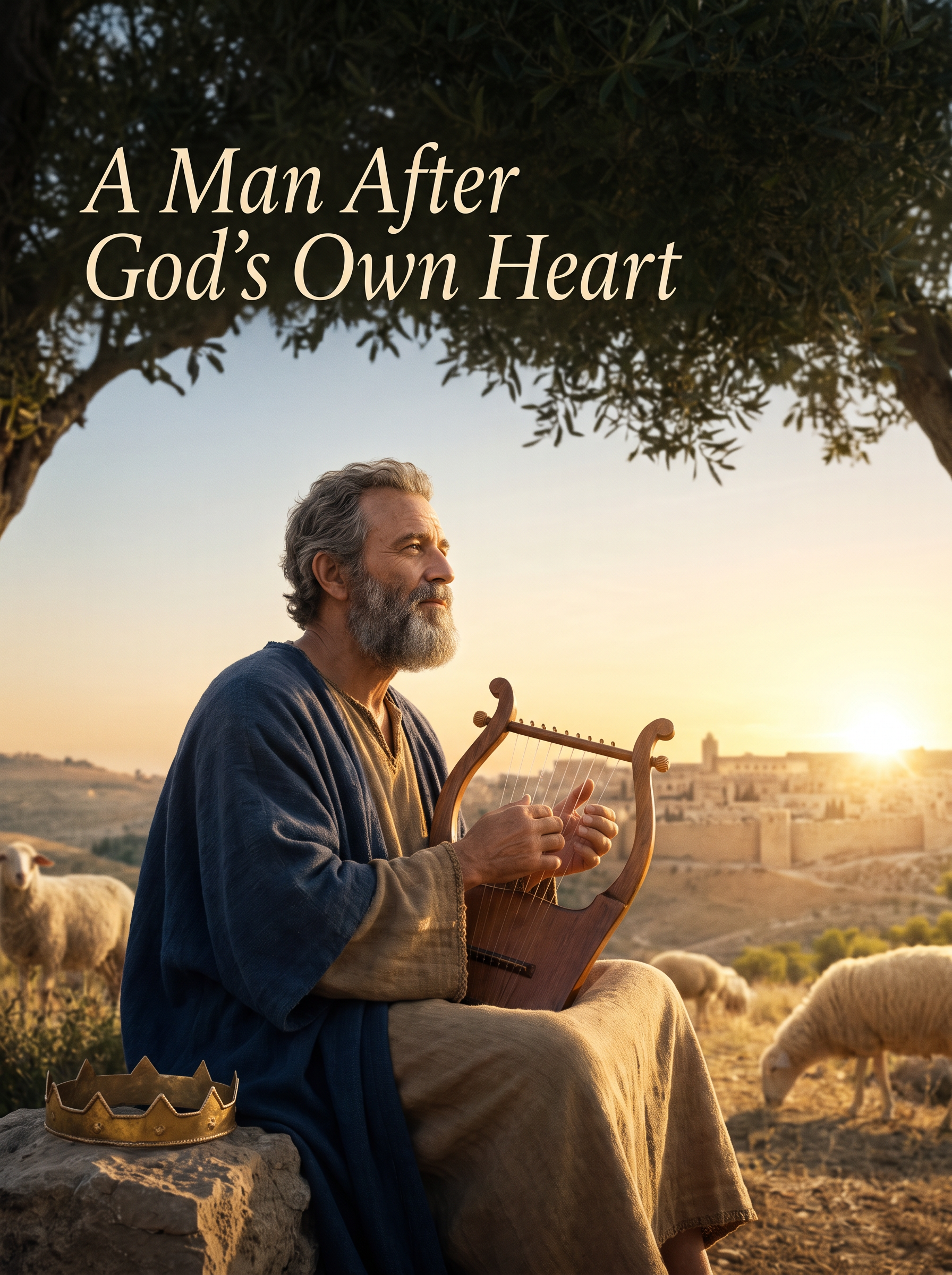
Series Finale: The Making of a King – The Life of David
We began this series with a boy nobody thought to call in from the field. We end it with an old king, dying, having built an empire, buried a son he loved, been forgiven for adultery and murder, and spent his final strength preparing a temple he would never see completed. In between, he danced half-dressed before the ark, spared the life of the man hunting him, wept over the very son who betrayed him, and confessed his sin without a single excuse.
Scripture sums up a life that complicated with a single, startling phrase: a man after God’s own heart. This final episode asks the question the whole series has really been circling from the start – why did that title belong to him?
The Scene: A Life Summed Up
The phrase itself comes early, long before any of David’s story had actually happened, spoken by Samuel to Saul as the reason for Saul’s own rejection:
“The LORD has sought out a man after his own heart, and the LORD has commanded him to be prince over his people.” (1 Samuel 13:14)
Centuries later, the apostle Paul repeats it, summarizing the same life we’ve spent this whole series studying:
“I have found in David the son of Jesse a man after my heart, who will do all my will.” (Acts 13:22)
And when David’s life finally ends, Scripture doesn’t dress it up as flawless. It simply says he was faithful to the assignment he was given:
“For David, after he had served the purpose of God in his own generation, fell asleep.” (Acts 13:36)
Not “after he had lived a perfect life.” After he had served God’s purpose. That distinction is the whole answer to this episode’s question.
It Was Never About Being Sinless
If we’ve learned anything walking through this series, it’s that David does not earn this title through moral perfection. He lied to a priest out of fear. He took another man’s wife and had that man killed to hide it. He numbered a people he wasn’t supposed to number, and seventy thousand people died for it. His household spent years unraveling from wounds he never fully addressed.
None of that got erased. None of it got minimized in the retelling. And yet God’s own assessment of David, spoken before most of that had even happened, still stands at the end: a man after His own heart. This should be enormously freeing for anyone who has quietly assumed that closeness with God requires an unblemished record. David’s story insists otherwise. The title was never about the absence of failure.
What It Was Actually About
So what did it mean? Looking back across everything we’ve studied, a few threads run through David’s whole life, and they’re the actual substance behind this title.
- He was chosen before he ever proved himself. Episode 1 showed us a boy overlooked by his own family, anointed anyway, simply because God saw something no one else did.
- He let the gap between calling and fulfillment shape his character instead of resenting it. Episode 2 showed us a young man who went back to the sheep after the oil dried, trusting God’s timing over his own urgency.
- He refused to seize what wasn’t his to take, even when the opportunity looked like providence. Episode 5 showed us restraint as its own form of worship; twice sparing the life of the man hunting him.
- He worshiped without protecting his own image. Episode 7 showed us a king dancing in the street, willing to be undignified in front of everyone except God.
- He loved God enough to offer what was never commanded. Episode 8 showed us a temple dreamed up out of pure affection, redirected by God into a promise that would eventually point to Christ Himself.
- He confessed without excuse. Episode 11 showed us the difference between David and Saul in six words: “I have sinned against the LORD.”
- He accepted consequence without losing faith in grace. Episode 12 showed us a man who could grieve honestly and still get up and worship, holding both truths without letting either one collapse.
- He held power loosely enough that losing it never unraveled him. Episode 13 showed us a king who could be driven from his own throne and still lead with humility, because his security was never actually built on the crown.
- He gave beyond what was required, even for something he’d never live to see finished. Episode 16 showed us an old man pouring his own personal wealth into a temple built entirely by someone else’s hands.
Put all of that together, and a clearer picture forms. God’s own heart isn’t defined by sinlessness. It’s defined by a particular posture – a heart quick to trust, quick to worship, quick to confess, and quick to love beyond what’s required. David wasn’t after God’s heart because he never fell. He was after God’s heart because he never stopped turning back toward it.
The Covenant That Outlived the King
We saw it in Episode 8, and it’s worth returning to here at the very end. David wanted to build God a house. God told him no, and then made a promise that reached far beyond anything David could have built with his own hands:
“Your house and your kingdom shall be made sure forever before me. Your throne shall be established forever.” (2 Samuel 7:16)
That promise didn’t end with David’s death. It didn’t even end with Solomon’s temple, which was eventually destroyed. It found its true fulfillment centuries later, in a way David himself could never have fully understood:
“He will be great and will be called the Son of the Most High. And the Lord God will give to him the throne of his father David, and he will reign over the house of Jacob forever, and of his kingdom there will be no end.” (Luke 1:32–33)
This is why Matthew’s gospel opens the entire New Testament by anchoring Jesus to this exact history: “The book of the genealogy of Jesus Christ, the son of David” (Matthew 1:1). Every episode of this series…the anointing, the giant, the cave, the dance, the temple dream, the fall, the repentance, the rebellion, the preparation…was quietly building toward a King who would succeed everywhere David fell short. David worshiped imperfectly; Jesus is worshiped perfectly. David repented of sin; Jesus had none to repent of. David’s throne was eventually lost to his descendants; Jesus’s throne, Scripture says, will never end.
Pastoral Insight: The Whole Series Was Never Just About David
If there’s one thing to carry away from this entire series, it’s this. David’s story was never really the destination. It was always pointing somewhere. His life – hidden boy, anointed king, worshiper, sinner, father, penitent, builder of what he couldn’t finish – was a long, textured picture of the kind of heart God has always been looking for. And it all points forward to the one King who would finally embody that heart without a single flaw.
That’s good news for every hidden boy in a field, every person waiting on an unfulfilled promise, every believer who has fallen further than they thought they could, and every person quietly preparing something they’ll never get to finish themselves. David’s heart was after God’s. And the whole reason that mattered is that it was pointing us, all along, to the heart of Christ.
Reflection Questions
- Looking back over this whole series, which episode of David’s life most reflects a season you’re currently in – hidden, anointed but unchanged, in a cave, on a throne, in exile, or preparing what you may not finish?
- David’s title wasn’t earned through sinlessness. Has this series changed how you think about your own closeness to God, especially in seasons of failure?
- How does knowing David’s whole story – including its worst chapters – change the way you read the title “Son of David” over Jesus?
A Closing Prayer for the Series
Lord, thank You for the whole of David’s story, not just the parts that inspire, but the parts that warn, and the parts that humble. Thank You that his life shows me closeness with You was never about perfection, but about a heart that keeps turning back to You. Give me David’s honesty in my failures, David’s worship in my joy, David’s restraint in my power, and David’s generosity in what I may never see finished. And most of all, thank You that every gap in David’s story finds its answer in Jesus, the true and better King, whose throne truly will never end. Amen.
Closing Thought for the Series
We started with a boy in a field, forgotten by everyone except God. We end with a king who was never perfect, but who never stopped turning back toward the God who first called him. Somewhere between those two points is the whole reason this life still matters three thousand years later – not because David got it all right, but because his heart, again and again, chose God anyway. May ours do the same.
Thank you for walking through the life of David. May his story remind you that God isn’t looking for flawless people- He is looking for hearts still willing to turn back to Him.
Leave a Reply