The Journey of the Exodus: From Slavery to the Promised Land
Theme: Idolatry is the attempt to control God. Even redeemed people can drift into self-made worship.
Scripture Reading
Exodus 32:1-8
Memory Verse: “You have made for yourselves an idol cast in the shape of a calf… So the Lord relented and did not bring on his people the disaster he had threatened” (Exodus 32:8, 14).
Diane had been a Christian for over a decade, faithful in her attendance, generous with her time, the kind of person people described as solid in her faith. But somewhere in the last few years, without ever deciding to, she’d started praying less and controlling more. When life felt uncertain, she didn’t wait on God. She managed the outcome herself, calling in favors, overworking, forcing situations into shape through sheer effort.
She still called it trusting God. She just quietly made sure not to actually need Him to come through.
It took a conversation with her sister, who gently asked why Diane seemed exhausted all the time, for her to notice what she’d built. Somewhere along the way, she’d started worshiping her own ability to fix things, and calling it faith. She hadn’t rejected God. She’d just replaced waiting on Him with something she could control herself, something that felt like God without requiring Him to actually show up.
The Scene
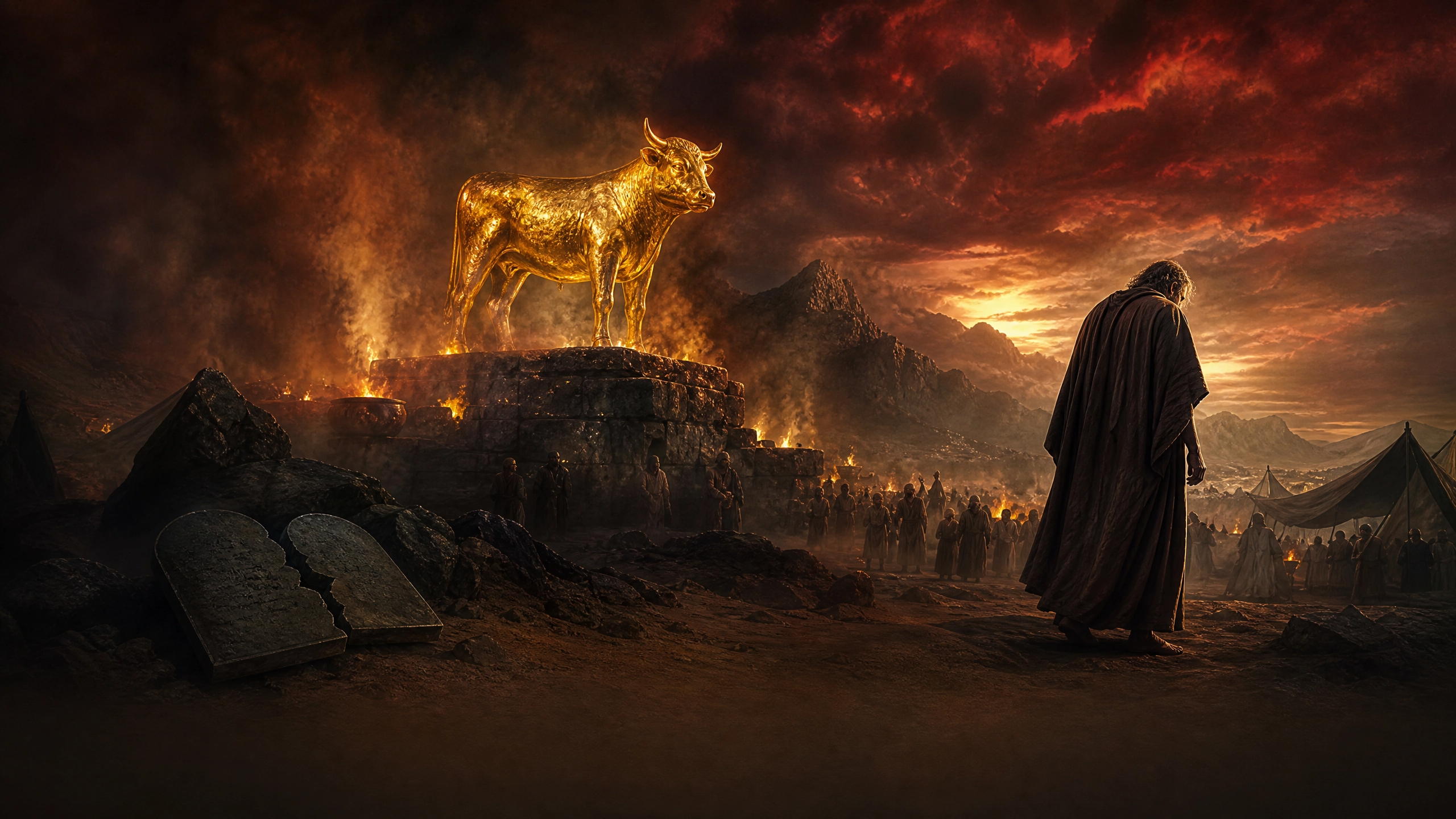
Moses had been on the mountain forty days, and Israel grew restless. They came to Aaron with a demand: “Come, make us gods who will go before us. As for this fellow Moses who brought us up out of Egypt, we don’t know what has happened to him” (Exodus 32:1).
Aaron collected their gold jewelry and formed a calf. The people declared, “These are your gods, Israel, who brought you up out of Egypt” (Exodus 32:4), then built an altar and held a festival “to the Lord” (Exodus 32:5). This detail matters. They weren’t abandoning God’s name entirely. They were building something they could see and control, then attaching His name to it anyway.
God’s response was immediate and severe, but Moses interceded, and Scripture records that “the Lord relented and did not bring on his people the disaster he had threatened” (Exodus 32:14).
Idolatry in Today’s World
- Idolatry rarely announces itself as rejecting God. Israel didn’t say “we reject the Lord.” They built a calf and called it worship of the Lord anyway. This is how idolatry usually works in a believer’s life. It doesn’t often look like walking away from faith. It looks like replacing trust in God with something manageable, then keeping God’s name attached to it for comfort. Diane never stopped calling herself a believer. She just quietly stopped needing God to be the one who came through.
- Idolatry is born from impatience with God’s timing. The calf wasn’t built the day Moses left. It was built after forty days of waiting, when uncertainty became unbearable. Waiting on God exposes what we actually trust. Israel couldn’t tolerate not knowing what came next, so they built something they could see and touch instead. Diane’s controlling wasn’t random either. It surfaced specifically in seasons of uncertainty, when trusting God’s timing felt harder than managing the outcome herself.
- Redeemed people are not immune. This is one of the most sobering details in Exodus. This was the same generation that had walked through the Red Sea, eaten manna, heard God’s voice at Sinai. Deliverance did not make them immune to drift. Salvation is the beginning of the story, not a vaccination against every future temptation. Diane’s decade of faithfulness hadn’t protected her from a slow slide into self-reliance dressed up as faith.
- Modern idols rarely look like statues. Few people today build golden calves. But the same pattern shows up in comfort we won’t surrender, control we won’t release, approval we chase harder than we chase God, achievement we quietly worship instead of the One who enables it. An idol is simply anything we trust to deliver what only God can, comfort, security, identity, then keep giving God’s name as a cover.
Idolatry rarely starts with a decision to reject God. It starts with impatience, a refusal to wait, and a decision to build something we can manage ourselves. The question worth asking isn’t whether you’ve built a golden calf. It’s what you’ve quietly started controlling instead of trusting God to handle.
Reflections
- Where have you replaced trusting God with managing an outcome yourself?
- What modern “calf” have you built, something manageable that you’ve quietly started to rely on more than God?
- Has waiting on God ever felt so uncomfortable that you reached for control instead?
Prayer
Lord, forgive me for the ways I have built something manageable and called it trust in You. Show me where impatience has led me to control instead of wait. Break anything I have quietly started worshiping in place of You, even if I have kept Your name attached to it. Teach me to wait well. In Jesus’ name, amen.
Closing Thought
Diane didn’t tear down an altar. She just started saying yes to uncertainty again, letting some things stay unresolved a little longer than felt comfortable, and calling that trust instead of calling her control faith.
Israel’s calf was melted down at the base of the same mountain where they’d heard God’s voice weeks before. Redemption doesn’t end the temptation to build something easier to manage. It just gives you a way back when you do.
Leave a Reply